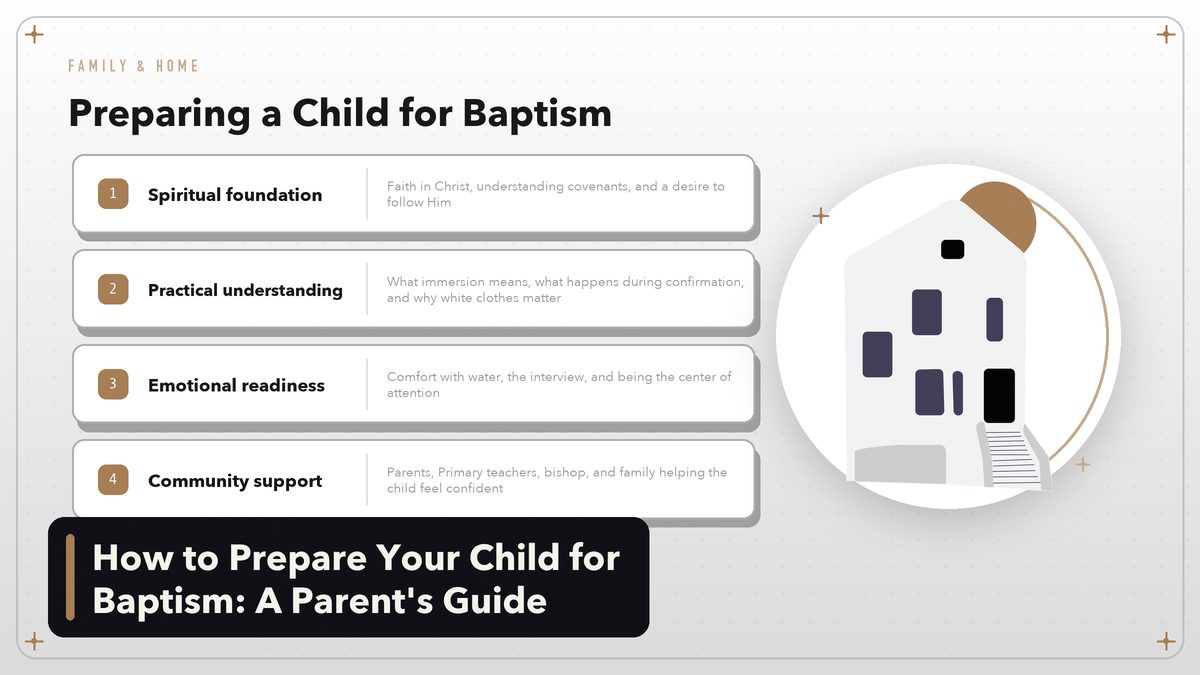
How to Prepare Your Child for Baptism: A Parent’s Guide
The night before my daughter turned eight, she worried aloud that the water would be cold. That turned out to be the simplest question of the whole weekend. The goal is simple. Let them put into their own words why Jesus Christ matters to them.
I was stopped at a red light when my son, then seven, asked it. “Do I have to get baptized, or do I get to?” The question sounded small until I tried to answer. In that moment I realized I had spent weeks thinking about white clothes, who would give the talks, and whether the building would be too warm. Almost no time went to helping him understand what the ordinance itself meant. I had missed the point. That stoplight conversation ended up shaping how our family approached every baptism after it.
Baptism is the first covenant a child makes in The Church of Jesus Christ of Latter-day Saints, so the preparation deserves more than a hurried conversation the week before the font fills. Parents hold a sacred duty to teach their children faith in Christ, repentance, baptism, and the gift of the Holy Ghost (D&C 68:25-27). It is worth the effort. What follows is the practical map I wish I had the first time around: what to teach, when to start, how to recognize readiness, and what baptism day looks like from a parent’s view.
Start With the Why, Not the When
Most parents begin thinking about baptism around a child’s seventh birthday. That makes sense. The Church teaches that children reach the age of accountability at eight (Gospel Topics: Baptism). But the date on the calendar should not drive the conversation. The covenant should.
I have watched families handle this in two different ways: one treats baptism like a birthday party with a spiritual program, something that happens because the child is turning eight. The other treats it as a personal decision the child is learning to make. Both celebrations can be beautiful. Only one leaves a child with a lasting sense of what they chose.
We are baptized because Jesus was baptized. Simple as that. We follow His example, make a covenant to take His name upon us, and receive the gift of the Holy Ghost to help us keep that covenant. Those ideas—example, covenant, companionship—are enough to anchor months of family conversation. If your child can explain, in their own words, why Jesus chose to be baptized and what it means to follow Him, they are further along than many adults realize.
Baptism is not a reward for turning eight; it is a covenant the child is learning to want and keep.
The Eight-Year-Old Milestone (and Why It Matters)
The age of eight is not arbitrary. It is intentional. In Latter-day Saint teaching, children are not baptized as infants because they are not yet accountable before God for their choices. By eight, they are old enough to understand right and wrong, to feel genuine sorrow for mistakes, and to choose for themselves whether to follow Christ. That is the shift. The Church’s handbook for members, True to the Faith, explains that little children are redeemed through Christ and are not baptized until they reach the age of accountability, which is eight (True to the Faith: Baptism).
Not every eight-year-old is the same. Some children are spiritually intuitive at six. Others do not engage with the ideas until they are nine or ten. That is okay. The age of eight is the beginning of accountability, not a deadline, and what matters is that the child understands enough to make the covenant meaningfully.
With our first child, we started too late and ended up cramming. With the second, the first child’s questions had already given our family a shared vocabulary around covenants, so we spread the preparation across almost a year. The difference was unmistakable. The second child was calmer and more confident, excited not just about the event but about the promise behind it.
What to Teach Before Baptism Day
The missionary lessons in Preach My Gospel organize doctrine around five core commitments: faith in Jesus Christ, repentance, baptism, receiving the gift of the Holy Ghost, and enduring to the end. That is the frame. Those five commitments are also the right frame for teaching a child (Preach My Gospel: Lesson 4). You do not need a formal lesson series. You need to weave these ideas into ordinary life.
Faith in Jesus Christ
Start right here. Keep coming back. For a child, faith in Christ often begins with the stories of the nativity, the miracles, the parables, and the Resurrection, but it grows when they begin to trust Jesus in their own life. Faith grows when they pray and feel heard, when they choose kindness because they want to be like Him, and when they notice that the gospel brings peace.
Ask direct questions. “What do you believe about Jesus?” “When have you felt close to Him?” Let them answer simply. Pause first. You are not looking for a polished testimony. You are looking for a real one.
Repentance
This is often the hardest topic for parents because none of us wants our children to feel shame. Repentance is not punishment. It is the process of turning back toward God after we have turned away. For a child, the most useful image is usually the simplest: say sorry, mean it, make it right, accept God’s forgiveness.
Practice this before baptism. When your child makes a mistake—and they will—walk them through the steps: recognize what happened, feel sorry, ask Heavenly Father for forgiveness, make restitution if needed, and move forward without carrying the mistake. On baptism day, they will understand. Repentance will always be available.
Baptism by Immersion
Children usually have practical questions long before they wrestle with the meaning. Will they go all the way under, will it hurt, or will the water be cold? Answer plainly. Yes, immersion means being completely covered by water for a moment. No, it does not hurt.
The water temperature varies by building. Most importantly, the person performing the baptism holds them carefully and uses the authorized words. Explain the symbolism: going under the water represents the burial of the old self, and coming up represents a new life as a follower of Christ. That is why baptism is sometimes called a rebirth. It is not magic. It is a visible sign of an invisible change of heart.
The Gift of the Holy Ghost
Many children are more nervous about confirmation than about baptism because it involves hands on their head and a blessing spoken in front of everyone. Explain what will happen. After baptism, one or more worthy Melchizedek Priesthood holders will lay their hands on the child’s head, confirm them a member of the Church, and give them the gift of the Holy Ghost.
The Holy Ghost becomes a constant companion, not a one-time feeling. He remains near. He brings comfort, warning, guidance, and testimony. Teach your child to notice the Spirit in ordinary moments: the quiet nudge to be kind, the calm after prayer, the sense that a scripture verse was meant just for them. Those small recognitions build confidence in the companionship they have been given by the Holy Ghost.
How to Know Your Child Is Ready
Readiness is not a checklist you grade; keep it simple. It is a direction you observe. Some children articulate deep things, while others show readiness through quieter signs like asking questions, choosing to pray on their own, or showing concern for someone else. Both are valid.

The key indicators I watch for are fairly simple. Do they understand the promise? Do they want to be baptized, or are they going along because it is expected? Can they talk about Jesus Christ as someone real and important to them? Can they recognize the Holy Ghost?
If the answer to most of these is yes, they are ready enough. Perfection is not the prerequisite. Desire is.
A Simple Six-Month Preparation Timeline
Six months is not a magic number, but it is long enough to let ideas sink in without feeling rushed. It is a useful length because it gives ideas time to settle without letting the preparation drag on so long that the child loses interest. Here is the loose timeline that worked for our family, adjusted to fit your own child’s pace.

Month one: open the conversation
Ask what your child already knows about baptism, what questions they have, and what feelings come up when they imagine themselves stepping into the font in white clothes. Read the story of Jesus’s baptism together. Do it together. Let them express doubts, excitement, or confusion without correction. This month, your job is to listen far more than you teach.
Month two: the covenant
Introduce the covenant idea. Use examples from daily life: marriage is one, and a promise between friends is another. Then talk about the baptismal covenant: we take Christ’s name upon us, keep His commandments, and serve others.
Month three: repentance in real life
Look for everyday chances to practice repentance. Use real moments. When your child is unkind to a sibling, help them apologize and make it right. When they forget a responsibility, help them own it and try again without shame. Connect these experiences to repentance.
Month four: the Holy Ghost
Spend time noticing the Spirit. After family prayer, ask what they felt, what they noticed, or whether anything seemed different from an ordinary conversation, and do not rush them if they cannot name it yet. When a scripture story moves them, name it. Teach them that the Holy Ghost can bring comfort, warn them, help them know what is true, and guide their choices.
Month five: baptism day details
Walk through the physical experience. Visit the baptismal font if possible. Talk about who will perform the ordinance, what they will wear, how the confirmation will happen, and what the program might include so there are no surprises on the day. Let them choose.
Month six: testimony and celebration
Encourage your child to write or draw their testimony. It does not need to be long or profound. A few sentences about what they believe is enough, because the value lies in the act of articulating belief more than in the length of the statement. Then plan the gathering. The spiritual event matters most, but a room full of family and friends afterward anchors the memory in love.
Baptism Day: What Actually Happens
The day itself is usually a mixture of reverence and mild chaos. Children are excited, relatives mill around, someone always forgets the white clothes, and the water is either colder or warmer than anyone expected, but the ordinance still carries its full meaning. That is normal.

Here is the typical sequence of events on baptism day. The child dresses in white. Family and friends gather in the chapel or relief society room. A brief program includes a welcome, a talk on baptism, a talk on the Holy Ghost, and music chosen to help the child feel the Spirit during the service.
Then the congregation moves to the font area. The child enters the water with the person baptizing them, the prayer is said, and the child is immersed completely under the water and raised again. After the baptism, the child changes into dry clothes and returns for the confirmation. The confirmation is usually part of the same service, with hands laid upon the child’s head and the words of the blessing spoken by inspiration.
If possible, let your child meet with the bishop or branch president beforehand. The bishop’s interview is not an interrogation. It reassures them. It is a loving conversation to make sure the child understands the covenant and genuinely wants to make it with Heavenly Father. Most children come out of that interview glowing.
After Baptism: Keeping the Covenant Alive
The day after baptism can feel like a spiritual letdown. The party is over, the relatives have gone home, and ordinary life returns, which is exactly when the real work of keeping the covenant begins. A baptism is not a finish line. It is the starting point of a life of discipleship.
Remember it together. Keep a photo from baptism day somewhere they will see it. Mention the anniversary. When they face a hard choice, remind them that they have the Holy Ghost to help them, and when they make a mistake, remind them that repentance still works exactly the same way. The baptismal covenant is kept one ordinary day at a time.
Mosiah 18 describes the people of Alma entering into the baptismal covenant with a willingness to bear one another’s burdens, mourn with those who mourn, and stand as witnesses of God at all times and in all places (Mosiah 18). Those are not abstract promises. They are lived out in how a child treats a lonely classmate, how they speak to a sibling, and how they show up at church even when they would rather stay home.
A Note for Converts and Blended Families
Not every child being baptized at age eight was born into an active Latter-day Saint home. Some are converts. Some are in blended families where one parent is not a member, and some have parents who are recently returning to activity after years away from the Church. If that describes your family, the principles here still apply, even if the practical details look different.
A child who is the only member in the household may need extra support understanding what comes next and knowing who they can turn to with questions. They need allies. A child with one parent who does not attend church needs reassurance that their covenant is real regardless of anyone else’s choices. In these situations, the ward family matters enormously. Primary teachers, youth leaders, ministering brothers and sisters, and faithful friends can help fill gaps without replacing the parent’s role.
When family complexity makes you unsure whether your child should be baptized, talk with your bishop. Ask for help. These conversations are common, and leaders are there to help, not to judge.
Your First Weekend Checklist
If baptism is approaching and you want a concrete starting point, here is a weekend-sized plan that will not finish the preparation but will set the tone. Start this weekend.
- Schedule a family council. Ask your child what they think and feel about baptism. Let siblings participate. Make it a genuine back-and-forth conversation, not a one-sided lecture.
- Read Jesus’s baptism together. Matthew 3 or 2 Nephi 31 both work well for family reading. Ask your child why Jesus, who was perfect, chose to be baptized even though he did not need to be.
- Write one question down. Have your child write or dictate one question they have about baptism, and commit to finding the answer together during the week.
- Meet with the bishop. If you have not already scheduled it, arrange the baptismal interview. Let your child know the interview is a friendly conversation.
- Plan the day practically. Decide who will perform the ordinance, who will give talks, what music you want, and what the child will wear, including whether they need white clothes brought from home. Logistics matter because calm logistics create space for spiritual focus.
- Choose one memory to keep. A journal entry, a photo, a recording of testimony, or a hand-drawn picture will help your child remember the feeling of the day years later.
The Covenant Begins at Home
My daughter’s question about the water temperature turned out to be a doorway into a much better conversation. We talked about why baptismal fonts are built the way they are, why white clothes matter, and what it means to go all the way under the water. Then we talked about the promise she would be making. By the time she stepped into the water, she was not just ready for the moment. She understood, at least a little, what it meant.
That is the real goal. Baptism is the first covenant your child makes, and the preparation is one of the most important teaching opportunities you will have as a parent. You do not need to be a theologian. You need to be present, honest, and willing to keep pointing your child toward Christ. The rest unfolds one ordinary day at a time.
This article reflects personal experience and study, and it is not an official Church statement or a substitute for Church doctrine. Scripture references and many other Church study resources can be read at ChurchofJesusChrist.org, where the full text of each passage is available in English and other languages: D&C 68, Mosiah 18. Official Church resources on baptism and Primary-age children include Gospel Topics: Baptism, True to the Faith: Baptism, and Preach My Gospel, Lesson 4, all available for further reading.