How to Write a Family History Story Your Family Will Actually Want to Read
Names, dates, and pedigree charts preserve facts. Stories preserve people. Here is a simple way to turn the names and dates you have already gathered into narratives your children, grandchildren, and cousins will want to read, remember, and pass along.
My aunt handed me the folder without much ceremony. “Grandma’s stuff,” she said. Inside were index cards in my great-grandmother’s cramped cursive, each one a life compressed to a line. “Ernest. Born 1912. Married Hazel, 1936. Died 1987.” Dozens of cards. Dozens of people. I sat at the kitchen table that afternoon feeling oddly sad. The cards were careful and complete, yet they were also unreadable, not because the handwriting was hard but because there was nothing on them that revealed what kind of man Ernest had been.
That folder changed how I think about family history. Genealogy is a good and worthwhile pursuit, and the Church has given us remarkable tools to do it. FamilySearch lets us build trees that stretch back centuries and helps us find ancestors we have never met. But records by themselves don’t make someone memorable. A birth date won’t tell you whether your great-grandmother laughed loudly or prayed quietly. A marriage certificate won’t capture the awkwardness of a first date or the relief of finding someone who understood her. Only stories do that.
Here’s the part that surprises people: you don’t need to be a professional writer to preserve those stories. You don’t need an English degree, a book contract, or quiet hours at a desk. What you need is one memory, a little curiosity, and the willingness to turn facts into scenes. This article will walk you through a practical process for writing family history stories that feel alive: how to find the story hiding inside the research, how to give it structure, how to write it in a voice that sounds like you, and how to share it in ways that invite your family in.
Why Stories Matter More Than Charts
The difference between knowing about someone and knowing them
Pedigree charts have their place. They show us where we came from, help us spot gaps, and make temple and family history work possible. The Church teaches that family history work helps members find their ancestors, prepare sacred ordinances for them, and preserve their stories. But that third part, preserving stories, is the one most of us skip, and it may be the part that matters most to the people we love.
Think about the relatives you remember best. You probably don’t remember them because someone told you their birth year. You remember the stories. The way your grandfather sharpened pencils with a pocketknife before doing the crossword. The way your mother cried at every baptism. The way your uncle told the same joke every Thanksgiving and still laughed hardest at the punchline. What stays with us are the small, specific details that reveal who a person actually was, the kind of details that turn a name on a chart into someone we feel we knew.
A birth date won’t tell you whether your great-grandmother laughed loudly or prayed quietly. Only stories do that.
There’s a spiritual reason to write stories too. The scriptures are full of people who understood this. Nephi began his record by saying he would write “the things of my soul.” He didn’t just keep a log of events. He wrote about fear, faith, family conflict, and revelation. Mormon abridged thousands of years of history by choosing stories that would teach us something about discipleship. When we write our family stories, we are doing something the Lord himself has always done, using the particulars of one person’s life to teach something true about faith, endurance, and grace.
Stories are also what the next generation will actually read. A GEDCOM file is useful. A wall chart is impressive. But a three-page story about how your grandparents met during a snowstorm, with a little dialogue and some suspense, is the thing your teenager will screenshot and share. If we want family history to matter to our children, we have to give them something human to hold onto.
Find the Story Hidden in Your Facts
Every ancestor has at least one scene worth saving
The hardest part of writing family history is not grammar or structure. It’s knowing where to begin. Most of us look at a census record or a gravestone and see only bare facts. But bare facts are the scaffolding around a life. Underneath them is a story waiting to be uncovered.
Start with one ancestor or one couple. Pick someone you’ve always been curious about, or someone whose name keeps showing up in your research. Then ask questions that facts can’t answer. What did this person want? What scared them? What was hard about their life? What made them laugh? Who depended on them, and whom did they depend on? Those questions turn a name into a person.
If you want to find the story hidden in your facts, look for the places where the record goes silent, because those gaps often hide the moments that shaped a person’s life. Silence usually means something happened that nobody wanted to talk about. These clues move family history from a collection of names into something your relatives might actually want to read around the dinner table. Here are a few specific places to look:
- Look for gaps and contradictions. A census shows a family of six children in 1910 and only three in 1920. What happened? A marriage record lists a witness nobody recognizes. A will leaves something unexpected to someone outside the family. Gaps are often where the story lives.
- Follow the hard seasons. Migration, war, illness, poverty, divorce, and death records are painful to read, but they’re also where courage shows up most clearly. You don’t have to dramatize suffering. You only have to honor it.
- Notice repeated places and occupations. Did your ancestor move every three years? Did three generations farm the same valley? Patterns of place and work reveal what people valued and what limited them.
- Ask living relatives before it’s too late. The fastest way to find a story is to ask someone who remembers. Our article on interviewing living relatives has a full list of questions, but even one phone call can yield details no record ever will.
Once you start looking for these patterns, you’ll be surprised by how quickly a name on a chart begins to feel like a person with a story worth telling.
The Anatomy of a Family History Story
Five pieces every narrative needs
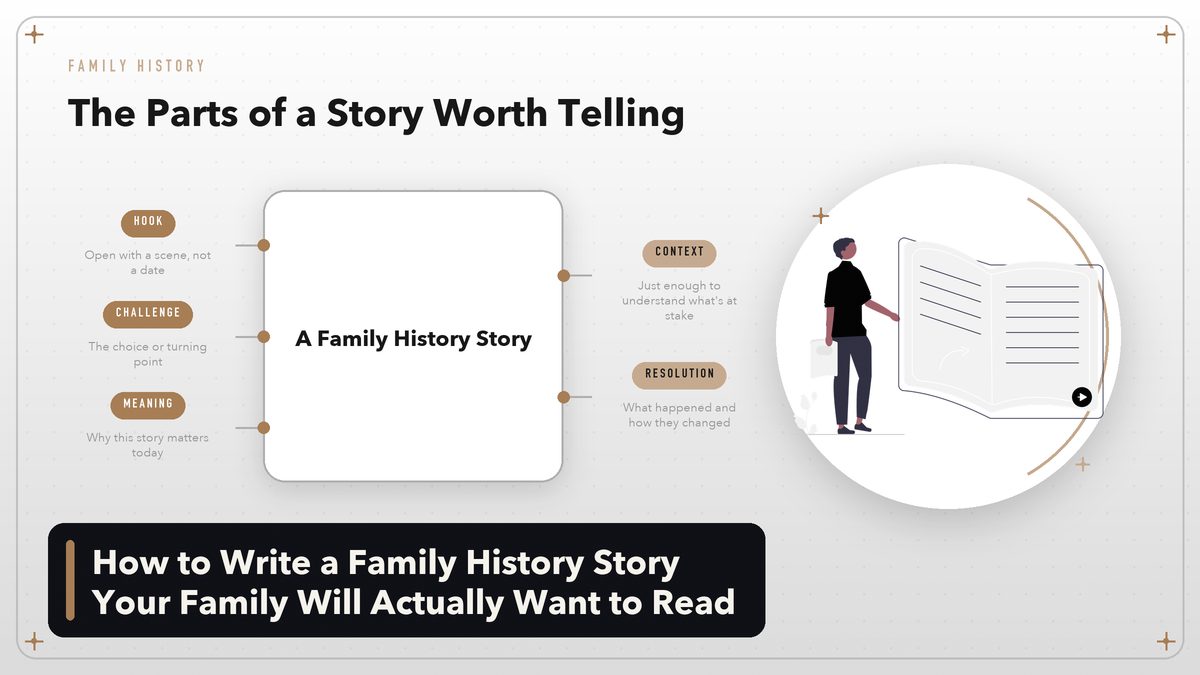
Family history stories don’t need to be long or fancy, but they do need structure. A good story gives the reader a person to care about, a moment of tension, and a sense of meaning. Think of it as five basic parts.
Open with a hook. Drop us into a scene, not a birth date. “In 1943, my grandmother stood on a train platform in Kansas City holding a suitcase and a one-way ticket to California.” That line does more work than “My grandmother was born in 1921.” It creates questions. Why is she leaving? What happens next? Will she be okay?
After the hook, give us just enough context to understand what’s at stake: where we are, what year it is, and what your ancestor wants or needs. Keep this brief. The goal is orientation, not a full genealogical report.
Then comes the challenge or choice, the moment when your ancestor has to decide whether to join the Church against their family’s wishes or walk away from a secure job to start over. The challenge doesn’t have to be dramatic. It only has to matter to the person living it.
Next, the resolution. What happened because of the choice? How did the person change? What did they learn? Sometimes the resolution is happy. Sometimes it’s complicated. Both are true to life, and both are worth recording.
Finally, the meaning. This is where you, the writer, explain why this story matters to you and your family today, whether it teaches something about faith, resilience, love, or sacrifice, or answers a question you’ve carried for years. This is the thread that connects the past to the present.

A Simple Writing Process That Actually Works
From scattered notes to a finished draft
Once you’ve found your story, the next challenge is getting it onto the page. Most people freeze here because they think the first draft needs to be good. It doesn’t. The first draft only needs to exist.
Set a timer for twenty minutes and dump everything you know. Write without stopping. Don’t worry about chronology, grammar, or elegance. Include the facts, the memories, the guesses, and the questions. If you don’t know something, write “I wonder” and keep moving. This raw material is more valuable than you think.
After the dump, find your focus. Read through what you wrote and ask: what is this story really about? Is it about courage? Faith? Loss? Migration? Forgiveness? Choose one theme and let it guide what you keep and what you cut. When a story has no focus, it tries to say everything at once and ends up saying nothing the reader can really hold onto and remember.
Build a simple outline next. Use the five-part anatomy above. Write one sentence for each part: the opening scene, the context, the challenge, the resolution, and the meaning. This gives you a skeleton, and a skeleton makes the writing much less scary.
Now write the draft in your own voice. Imagine you’re telling the story to a curious cousin at a family reunion. Use contractions. Use short sentences. Use the words you actually use. If you’d say “my grandpa” instead of “my paternal grandfather,” write “my grandpa.” Warmth beats formality every time.
Add sensory detail once the draft is down. What did the room smell like? What was the weather? What sounds were in the background? Sensory details make a scene feel real. Instead of writing “They were poor,” write “The kitchen smelled of cabbage and coal, and the children shared one bed in the corner.” Show, don’t just tell.
Revise for clarity last. Read the draft out loud. Cut anything that sounds like a textbook. Add transitions where the reader might get lost. Check your facts against your sources. Then read it once more and ask: does this sound like a real person lived it?

What to Do When the Facts Run Out
Honest guesses are better than silence
One of the most common fears in family history writing is getting something wrong. We worry that if we don’t know every detail, we shouldn’t write at all. But silence is the real enemy. A story with a few honest gaps is still better than no story.
When you don’t know exactly what happened, say so. Phrases like “I imagine she felt,” “family tradition says,” or “the record doesn’t tell us, but it seems likely” keep you honest while still bringing the scene to life. Readers can tell the difference between a writer who is guessing carefully and one who is making things up. The first is trustworthy. The second is not.
You can also use historical context to fill in the world around your ancestor. If you know your great-great-grandfather worked in a Pennsylvania coal mine in 1890, you can describe what a coal miner’s day was like without claiming you know his exact thoughts. The scriptures and General Conference addresses often use this same technique, grounding timeless principles in the lived experience of real people.
Another option is to write around the gap. If you don’t know why your ancestor left Norway, you can still write about what it meant to leave, describing the fjord, the ship, the farewell, and the arrival. The emotional truth doesn’t depend on knowing every motive.
Silence is the real enemy. A story with a few honest gaps is still better than no story.
Common Mistakes and How to Fix Them
Avoid the traps that make family history feel dead
Most family history writing fails for the same few reasons. The good news is that all of them are fixable.
Starting with genealogy instead of story is the first trap. “John Brown was born on March 4, 1876, in Olathe, Kansas, the third child of William and Mary Brown” is not an opening. It’s a database entry. Start with a scene, a question, or a problem. Save the vital statistics for later, or weave them into the action.
Passive, distant language is the second trap. “The farm was purchased by the family” is weaker than “My great-grandfather saved for seven years and bought forty acres of rocky Missouri hillside.” Active verbs give your ancestors agency. They make them doers, not just people things happened to.
Another common problem is trying to cover an entire life in one story. A cradle-to-grave summary is almost always boring because it has no focus. Choose one chapter of a life and tell it well. You can write other stories later.
The last mistake is leaving yourself out of the story. Family history isn’t just about the past. It’s also about what the past means to you. A sentence like “When I read this letter, I realized my grandmother had been braver than I ever knew” connects generations in a way that facts alone cannot.
| Mistake | Fix |
|---|---|
| Opening with dates and places | Open with a scene, a question, or a small moment |
| Passive, distant language | Use active verbs and let your ancestor make choices |
| Trying to cover a whole life | Choose one event, decision, or season to focus on |
| Forgetting the writer’s connection | Tell the reader why this story matters to you today |
| Writing for a general audience | Write for one real family member who wants to know |
Share the Story in Ways That Invite Your Family In
A finished story is only the beginning
Writing the story is half the work. The other half is getting it into the hands of people who will care about it. Fortunately, there are more ways to share family history today than ever before.
The simplest option is to print it. A two-page story tucked into a Christmas card or a family reunion packet is a gift people can hold. Print on decent paper. Add a photo if you have one. Include a short note explaining why you wrote it. Physical copies have a way of surviving moves, decluttering sprees, and computer crashes in ways that forwarded emails and cloud links rarely manage to do.
Another option is to attach the story to your FamilySearch tree. FamilySearch allows you to add memories, photos, and documents to individual ancestor profiles, so when you upload a written story, it becomes part of the shared family record. If you’re new to FamilySearch, our article on getting started with FamilySearch walks through the basics.
You can also read the story aloud at a family gathering. There is something powerful about hearing a family story in a room full of relatives. It turns a private research project into a shared memory. Reading aloud also gives relatives permission to add their own memories, and those small corrections or additions often become the best parts of the finished piece. Keep it short, five minutes or less, and invite others to add what they remember.
For younger family members, consider adapting the story. A teenager might prefer a social media post with a photo and a short caption. A child might like a simplified version with a drawing. The goal isn’t to make the story flashy. The goal is to make it accessible to the people you love.
Start Where You Are
One small story is enough
You don’t need to write a book. You don’t need to finish your family tree. You don’t need to know everything about every ancestor. What you need is one memory, one question, and one afternoon.
The Church has long taught that family history work blesses both the living and the dead. President Russell M. Nelson has encouraged Latter-day Saints to prepare as many names for the temple as possible and to gather their families on both sides of the veil. Writing stories is one way to do that gathering work. It says to the next generation: these people mattered. Their choices shaped us. Their faith, their struggles, and their love are part of who we are.
So pick one ancestor. Set a timer for twenty minutes. Write one scene. Don’t worry about making it perfect. Worry about making it true. The story you write today may be the one your granddaughter reads fifty years from now, the one that helps her feel less alone in her own hard season, the one that reminds her she comes from people who kept going.
That isn’t just family history. It’s a gift only you can give, one that grows more precious each time a grandchild reads it, remembers where she came from, and realizes she belongs to a long line of people who kept faith alive.
Sources and related reads: This article references FamilySearch, the Church’s scriptures, General Conference addresses, and the Topical Guide and Guide to the Scriptures entries on records. For more help, see our articles on getting started with FamilySearch, interviewing living relatives, and preserving family photos.