How to Hold a Family Council That Actually Works
A family council is not a staff meeting in matching sweatshirts. It’s a chance to slow down, listen to each other, and let the gospel shape the small decisions that make up a home.
Picture a Tuesday night when every conversation about schedules, money, or screen time ends with someone leaving the room. Nobody is furious. Everyone is just tired of making decisions on the fly. At some point, the parents look at each other across the kitchen table and admit the obvious: they’re running a household, but they aren’t really leading a family. That’s the moment a family council starts to make sense. Not because a whiteboard will fix everything. Because the family needs a place to turn toward each other on purpose.
The first council is almost always awkward. The toddler crawls under the table. The teenager acts like you’ve asked her to audition for a play. Someone wants to open with a prayer, and someone else asks if that means you have to close with one too. But if you keep it short—ten or fifteen minutes—and ask two simple questions, the tone shifts. What’s working in our family right now? What’s one thing we want to do better this week? In less time than it takes to fold a load of laundry, you can have a plan for Family Home Evening, a small carpool change, and a new rule about phones at dinner. More importantly, you’ve talked to each other like a team instead of like roommates passing in the hallway.
The Church has taught the value of family councils for a long time. In a 2016 general conference address on family councils, Elder David A. Bednar explained that councils are one way parents fulfill their sacred duty to teach, lead, and love their children. They are not a replacement for personal revelation or parental authority. They are a setting where parents and children counsel together, listen to the Spirit, and make decisions as a united family. Once I heard it put that way, the weekly calendar meeting on our couch stopped feeling administrative and started feeling spiritual.
Why a Family Council Is Worth the Effort
It turns a house full of schedules into a household with a purpose
Most families already hold councils without naming them. Someone asks what to do this weekend. Someone else wants to talk about the dog. A group text bounces back and forth about who is picking up milk. These moments are small and necessary, but they are reactive. A real family council is proactive. It creates a regular space where the whole family looks ahead, listens to each other, and decides together.
The proclamation on the family teaches that parents have a solemn responsibility to love and care for each other and their children, and that happiness in family life is most likely when it’s founded on the teachings of Jesus Christ. A council is one practical way to put that foundation under daily life. When a family councils together, they aren’t just solving problems. They’re practicing the gospel pattern of counsel, prayer, and unity.
There’s also a quieter benefit. Children who sit in a council learn that their voice matters. They hear their parents ask questions instead of issuing edicts. They watch disagreements handled without shouting. They see a decision get made, assigned, and followed up on. That is discipleship training disguised as a meeting. The Gospel Topics essay on family reminds us that the family is central to the Creator’s plan. A weekly council is a small but concrete reminder of that centrality.
The goal of a family council isn’t efficiency. It’s unity, one conversation at a time.
When to Hold a Family Council
Pick a rhythm, not a crisis
Family councils work best when they’re regular, not dramatic. If the only time you call one is when someone is in trouble, everyone will start to associate the word “council” with punishment. A better approach is to make it part of the normal rhythm of the week. Lots of families hold a short council on Sunday evening, after dinner, or before the new week begins. Others do it on Saturday morning when the calendar is still flexible.
The schedule matters less than the consistency. A fifteen-minute council every week will do more for your family than a two-hour council every few months. The point is to create a predictable moment when everyone knows the floor is open. Over time, that predictability lowers the stakes. A teenager is more likely to bring up a hard topic on a Sunday evening if she knows that’s the space for it than if she has to request a special family meeting.
There are also moments when an extra council makes sense. A big decision about moving, changing schools, or caring for an aging relative deserves a formal council. A conflict that keeps resurfacing may need one too. But even then, the best councils happen inside a habit of regular conversation. If the only time you talk as a family is when something is wrong, the talking itself becomes the problem.
The Anatomy of a Working Council
Five simple parts that keep it from becoming a lecture
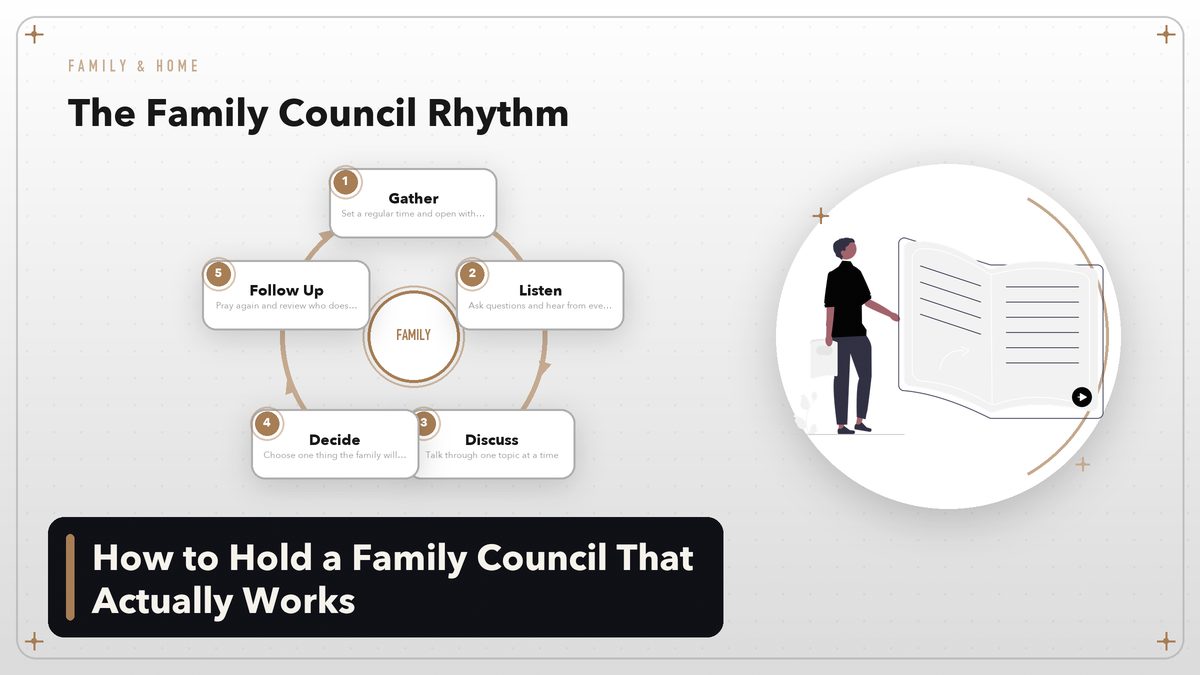
A good council has a shape. It doesn’t have to be rigid, but it does need a beginning, a middle, and an end. Without that shape, the conversation drifts, one person dominates, and everyone leaves feeling like nothing was decided. With it, even a hard conversation can end with a sense of direction.

1. Open with prayer and a purpose
Starting with prayer isn’t just a formality. It invites the Spirit into the room and reminds everyone that this isn’t a business meeting. Keep the prayer short and sincere. Then state the purpose. “Tonight we want to plan the week and talk about one thing that has been hard.” That single sentence gives the council a center of gravity.
2. Listen before leading
Parents need to speak, but they also need to listen first. Ask an open question and let everyone answer. “What’s one thing that went well this week?” “What’s one thing that felt hard?” The answers may surprise you. A child who seems distant might reveal that school is overwhelming. A spouse might mention a worry you didn’t know was there.
The Teaching in the Savior’s Way manual emphasizes that the Savior asked questions and listened to the answers. Family councils are a chance to follow that pattern. When we listen first, we teach our children that their perspective is valuable to us and to the Lord.
3. Discuss one topic at a time
It’s tempting to load the agenda with every unresolved issue in the house. Resist that temptation. Pick one topic and stay there until the family has a sense of direction. If other issues come up, write them down for a future council. This discipline protects the conversation from becoming a grievance session.
4. Decide one thing
A council without a decision is just a conversation. The decision doesn’t have to be major. It might be, “We’ll have a no-phone rule during dinner.” It might be, “We’ll visit Grandma on Saturday.” The important thing is that the family leaves knowing what was decided and who is responsible for making it happen.
5. Close with prayer and a plan
End the way you began, with prayer. Thank Heavenly Father for the conversation. Ask for help living the decision you made. Then quickly review who is doing what. A closing sentence like, “So Dad will schedule the visit, and the rest of us will think of one thing to bring,” turns a decision into action.
What to Actually Talk About
A menu of topics so the council never runs out of purpose
One reason councils fizzle is that nobody knows what to say. The silence gets uncomfortable, and someone jokes, “So, same time next week?” Having a rotating list of topics helps. It also keeps the council from turning into a problem-only meeting. Some weeks should be about celebration and planning, not just fixing what is broken.
| Topic area | Example questions | Why it matters |
|---|---|---|
| Calendar and logistics | What appointments, trips, or deadlines are coming? Who needs a ride? | Keeps the practical side of family life from becoming a daily negotiation. |
| Gospel goals | What can we do this week to study the scriptures or serve someone? | Connects the council to the Church’s Come, Follow Me home-centered learning. |
| Family traditions | What holiday, birthday, or ritual do we want to plan or preserve? | Builds identity and gives children something to look forward to. |
| Concerns and conflicts | Is there tension we need to talk through calmly? | Addresses issues before they become resentments. |
| Service and hospitality | Who around us needs a meal, a visit, or a prayer? | Turns the family’s attention outward. |
Not every topic needs a formal vote. Sometimes a council is simply a place to share information and pray together. The goal isn’t to manufacture decisions. The goal is to keep the family communicating.
Keeping the Council From Becoming a Lecture
The difference between a council and a parent press conference
The fastest way to kill a family council is for Mom or Dad to do all the talking. If the council becomes a weekly announcement of rules and consequences, the kids will tune out. They may show up physically, but they won’t show up emotionally. A real council requires genuine dialogue.

Here’s the difference in practice. A lecture-style council sounds like this: “Here’s what we’re doing this week. Here are your chores. Does everyone understand?” A dialogue-style council sounds like this: “We have a busy week ahead. What do you all think is the most important thing we need to protect?” The first approach gets compliance. The second gets ownership.
That doesn’t mean parents abdicate their role. Parents preside, provide, and protect. They set the moral boundaries and make the final call when necessary. But within those boundaries, there’s a lot of room for children to contribute. A ten-year-old can help decide how to handle a conflict with a sibling. A teenager can propose a plan for managing screen time. Even a young child can choose a family activity or a song for Family Home Evening.
The best councils don’t end with parents feeling heard. They end with children feeling heard too.
Including Every Age in the Circle
A council changes shape as children grow
Family councils look different with toddlers than they do with teenagers. With young children, the council may be very short and very concrete. “This week we’re going to practice being kind to our sister. Who can show me what that looks like?” With teenagers, the council may involve more debate, more silence, and more respect for their growing independence.
The trick is to include everyone at the level they can participate. A three-year-old can help pick a picture for Family Home Evening. A six-year-old can report on how a goal went. A twelve-year-old can take notes or lead part of the discussion. A teenager can be asked for real input on a family decision, not just asked to agree with what the parents already decided.
Older children and adult children can be part of councils too. A college student home for the summer, a married child visiting, or an aging parent living in the home all bring perspective. The council becomes a living picture of what Elder Bednar described: a place where parents and children counsel together for the good of the family.
When the Council Gets Hard
Conflict, silence, and decisions that don’t stick
No family council is perfect. Sometimes voices rise. Sometimes nobody talks. Sometimes a decision is made and ignored by Wednesday. These moments don’t mean the council is failing. They mean the council is real.

When conflict shows up, the first thing to do is slow down. You don’t have to solve the issue in one meeting. You can say, “This is important, and I want us to handle it well. Let’s pray and come back to it tomorrow.” That pause honors the topic and protects the relationship. It also models that strong feelings are not emergencies.
When a child is silent, don’t force a speech. Instead, offer a different way to contribute. “You don’t have to talk right now, but I’d love to know your thoughts later, just between us.” Some children process internally. They need time and a private door, not public pressure.
When a decision falls apart, treat it as information, not failure. Ask, “What got in the way?” Maybe the decision was unrealistic. Maybe someone needed more support. Maybe the follow-up was unclear. Adjust and try again. A council is a practice, not a performance.
Making It Stick
Habits, not heroics, make a council last
The families who benefit most from councils aren’t the ones with the best agendas. They’re the ones who keep showing up. Consistency beats perfection every time. A council that happens every week for ten minutes will shape a family more than an elaborate council that happens once and never again.
Put it on the calendar. Protect the time the way you would protect a dentist appointment or a piano lesson. Turn off notifications. Gather in the same spot. Use a simple format so nobody has to reinvent the wheel. One family I know keeps a small notebook where they record decisions, prayer requests, and follow-ups. When they open that notebook, everyone knows it’s council time.
Start and end on time. If a council always runs long, people will dread it. If it always ends with a sense of energy, they’ll look forward to it. When a meeting is going in circles, the parent can gently say, “Let’s decide this one thing and move on.” That discipline is a form of love.
Finally, keep it gospel-centered. Read a verse of scripture occasionally. Share a testimony. Pray specifically for the concerns raised. The Come, Follow Me resources can easily feed into a council. When the gospel is the atmosphere of the council, the council becomes something more than good communication. It becomes a way of building Zion in one living room.
Starting Where You Are
You don’t need a perfect family to begin
If the idea of a family council feels intimidating, start small. You don’t need a whiteboard, an agenda binder, or unanimous enthusiasm. You need a kitchen table, a few minutes, and a willingness to try. The first council may be short. The second may be slightly less awkward. By the fifth or sixth, you’ll begin to notice a shift. People will start saving topics for council night. Children will remind you when it’s time. The conversation will feel less like management and more like ministry.
Most families still have councils that go sideways. Someone rolls their eyes. Someone interrupts. Someone forgets the decision before the week is out. But they also have something they didn’t have before: a regular place where they turn toward each other and toward the Lord. That place becomes one of the best things about a home.
Heavenly Father organized us into families because He knew we would need each other. A family council is one way to honor that organization. It isn’t complicated. It isn’t fancy. It’s simply a room full of people who love each other enough to listen, pray, and decide together. That’s worth the awkward beginning.
External sources checked live before publishing: Elder David A. Bednar, “Family Councils,” October 2016 general conference; “The Family: A Proclamation to the World”; Gospel Topics: Family; Teaching in the Savior’s Way; and the Church’s Come, Follow Me home-centered learning resources.