How to Strengthen Your Testimony One Small Step at a Time
A testimony is not a light switch you flip on once. It’s more like a garden you tend in every season, with ordinary acts of faith, study, prayer, and obedience doing the quiet growing.
I admitted it out loud one Sunday after sacrament meeting. My testimony felt thin. Not gone. Not shattered. Just thin, like a shirt worn too many washes. I was standing in the foyer holding a hymnbook I hadn’t opened, and the closing prayer had already faded into the chatter of people heading for the parking lot. Nothing dramatic had happened. Work had swallowed my mornings, scripture reading had shrunk to a verse or two when I remembered, and prayer had become a quick sentence before I rolled over to sleep. I looked around and wondered how many other people in that hallway were quietly carrying the same feeling.
That afternoon I did one small thing. I opened my scriptures to Alma 32 and read the faith-seed parable for the first time in months. No lightning bolt. No tears. But something shifted, a slight loosening of the rust that had gathered around my heart. The chapter reminded me that faith begins as a desire to believe and grows through patient nurturing (Alma 32). It wasn’t the chapter that changed me. It was the fact that I showed up.
Strengthening a testimony is less about grand gestures and more about repeated small choices. The Church’s Gospel Topics essay defines testimony as a spiritual witness given by the Holy Ghost that certain facts of eternal significance are true (Gospel Topics: Testimony). That witness can become brighter and steadier, but it rarely grows in isolation. It grows in the soil of daily discipleship.
Stop Waiting for a Big Moment
Most of us carry an unspoken idea that testimonies are built through mountaintop experiences. We picture Alma the Younger struck to the earth, Joseph Smith in the Sacred Grove, or Paul on the road to Damascus. Those stories matter. They are real. They are also not the standard pattern for ordinary disciples. Most testimony growth happens in the valleys, on Tuesday afternoons, during dishes.
I once asked my grandmother how she kept her faith strong through decades of ordinary life. She smiled and said she couldn’t remember a single defining moment, only thousands of small ones. A verse that stuck with her during a hard week. A prayer answered in a way she didn’t expect. A sacrament hymn that reached her when nothing else could. Her testimony wasn’t one dramatic story. It was a mosaic built from tiny tiles of attention and trust.
Elder Jeffrey R. Holland taught that faith is not a perfect knowledge and that even those who struggle to believe are invited to hold fast to what they hope is true (Elder Holland, “Lord, I Believe,” April 2013 general conference). That permission matters. You don’t need a burning bush to be a faithful person. You need a willingness to keep showing up, even when the feelings are faint.
Testimony is not a single event to achieve. It’s a direction to keep choosing, one ordinary day after another.
The Anatomy of a Growing Testimony
Five roots that feed a stronger witness
It helps to think of a testimony as having several connected parts rather than one simple on-off switch. The Church’s True to the Faith booklet explains that a testimony is a conviction of the reality, truth, and goodness of God, of the life and mission of Jesus Christ, and of the restored gospel (True to the Faith: Testimony). Those convictions don’t all grow at the same speed, and that’s normal.

Belief in God the Father
This is the foundation. Do you believe there is a loving Father in Heaven who knows you personally? That belief grows when you notice His hand in your life, when you thank Him for small blessings, and when you remember moments when you felt known and cared for.
Faith in Jesus Christ and His Atonement
This is the center. A testimony of Christ grows as we study His life, rely on His grace, and try to follow His example. It isn’t only knowing that He lived. It’s trusting that His sacrifice reaches your actual mistakes and pains.
The Restoration of the gospel
This includes the reality of Joseph Smith’s First Vision, the Book of Mormon as scripture, and the ongoing leadership of prophets and apostles. This part of a testimony is often strengthened through study, prayer about the Book of Mormon, and watching how the Church functions across the world.
The principles and ordinances of the gospel
Faith, repentance, baptism, the gift of the Holy Ghost, and enduring to the end are not abstract ideas. They are practices. The more consistently you live them, the more real they become.
The guidance of the Holy Ghost
A testimony is not merely intellectual agreement. It is spiritual confirmation. Learning to recognize the Holy Ghost’s voice, promptings, peace, warnings, and witnesses is a skill that develops through patient attention.
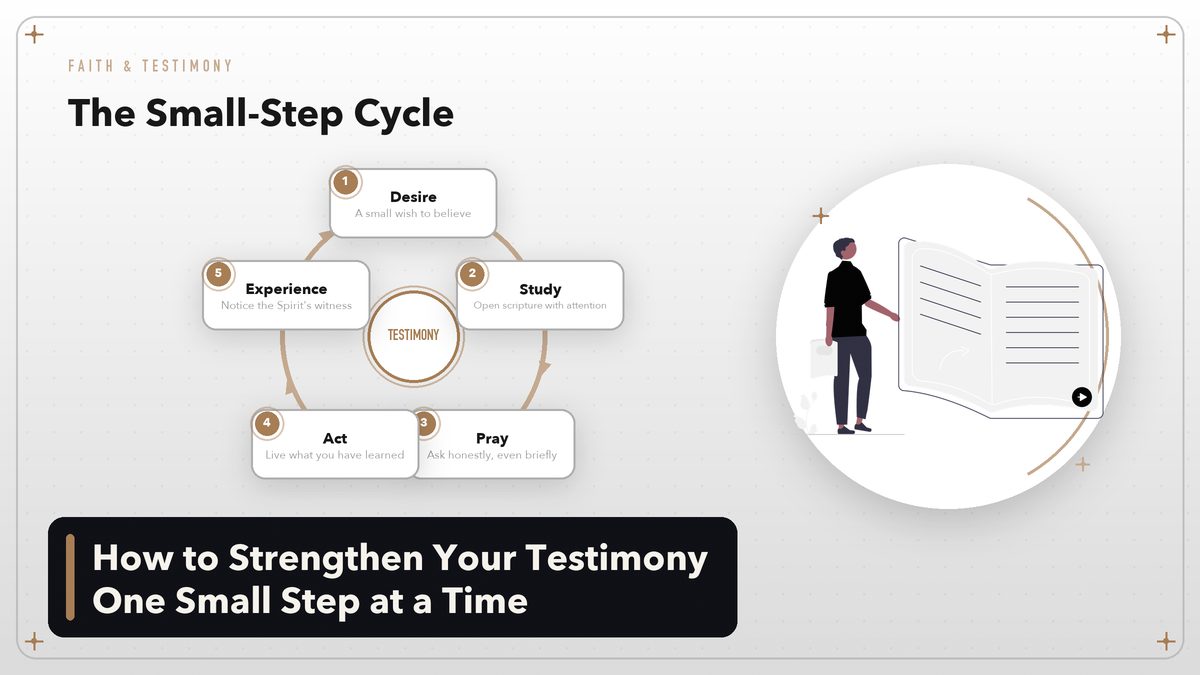
The Small-Step Cycle
Alma 32 compares faith to a seed that must be planted, nourished, and cared for. Neglect it and it withers. Feed it and it grows into a tree bearing fruit. That metaphor is the heart of testimony building. The nourishment isn’t one dramatic act. It’s repeated, ordinary care.

Here’s how the cycle works in daily life. A small desire to believe leads you to open your scriptures. Reading creates a thought or question that stays with you. You pray about it, maybe not eloquently, but honestly. An answer may come quickly, slowly, or in a way you didn’t expect, but the act of praying keeps the channel open. Then you act on what you’ve learned, even imperfectly. Action produces experience, and experience produces conviction. That conviction then feeds a deeper desire, and the cycle begins again.
The Preach My Gospel manual teaches missionaries that faith in Jesus Christ leads to action and that action strengthens faith (Preach My Gospel, Chapter 6). The same principle applies to every member. Faith isn’t passive. It moves. And movement makes it stronger.
Simple Practices That Actually Build Testimony
There’s no secret formula. The practices that strengthen testimony are the ones you’ve heard since Primary, but their power lies in consistency rather than novelty. What matters is doing them with attention, not doing them perfectly.
Read the scriptures, even briefly
You don’t need to finish a chapter a day. You need to let the words reach you. Some days that might be three verses and a pause. Other days it might be a whole chapter and a notebook page. The quantity matters far less than the regularity. Reading the Book of Mormon consistently, even a little, has a cumulative effect that reading in large sporadic bursts can’t replicate.
Pray out loud when you can
Silent prayers are valid and necessary, but spoken prayer has a way of clarifying what you actually believe. Hearing yourself thank God, ask for help, or admit confusion makes the relationship more concrete. Pray in the car, in the shower, on a walk. Make it a conversation rather than a performance.
Keep a spiritual journal
Memory is unreliable. A simple journal becomes evidence of God’s care over time. Write one sentence about something you noticed spiritually each day. After a few months, you’ll have a record of patterns, answers, and growth that your present feelings can’t erase.
Serve someone else
Testimony grows when it moves outward. Service takes your focus off your own doubts and puts it on someone else’s needs. It also mirrors the life of Christ. A ministering assignment, a meal for a neighbor, or a text to someone lonely can become a surprisingly powerful faith-building moment.
Attend church even when you don’t feel like it
The sacrament is the weekly anchor. Taking the bread and water in remembrance of Christ is not merely symbolic. It is a covenant-renewing act that keeps the relationship alive. Sundays when you feel least like attending are often the Sundays you need it most.
Ask real questions
Questions are not the enemy of testimony. They’re part of how it matures. What matters is where you take them. Bring questions to God, to scripture, to trusted leaders, and to faithful friends. Avoid the trap of only taking questions to sources that already assume the answer you fear.
What to Do When Your Testimony Feels Thin
Every faithful person I know has seasons when belief feels distant. It doesn’t mean you’re broken, unworthy, or on the verge of losing your faith. It usually means you’re human, and your testimony needs some ordinary care.
When my own faith feels thin, I’ve learned to stop panicking and start investigating. I ask myself a few diagnostic questions. Am I sleeping enough? Am I spending too much time online? Have I been praying, or just thinking about praying? Have I been reading scripture, or just reading about scripture? Often the distance I feel has a practical cause, and the remedy is equally practical.
Sometimes the thinness comes from real questions that deserve real attention. In those moments, it helps to remember Elder Holland’s counsel that a perfect, unfailing faith is not required, but rather a determination to believe and to hold on (Elder Holland, “Lord, I Believe”). You can carry a question and still carry faith. You can admit uncertainty and still choose to keep the commandments.
Doubt handled with humility becomes a doorway to deeper faith. Doubt handled with fear becomes a wall.
The Role of Community in Strengthening Faith
Testimony is personal, but it’s not private. We are built to believe in community. The scriptures describe the Church as a body, with each member supporting the others. When your faith is weak, someone else’s faith can carry you for a while.
I’ve been carried by my ward family more times than I can count. A Sunday School teacher who answered a question with patience rather than dismissal. A friend who noticed I was quiet and invited me to lunch. A home teacher who showed up during a hard month with no agenda except love. Those people weren’t replacing my testimony. They were reminding me that the gospel still worked in real lives.
Community also gives us accountability and perspective. When we only listen to our own thoughts, our doubts can echo and amplify. Hearing others share their faith, their struggles, and their witnesses helps us remember that we are not alone in the work of believing.
A 30-Day Testimony-Building Experiment
If you want a structured way to begin, try this simple experiment. It isn’t a guarantee, but it’s a pattern that has helped many people feel the slow return of spiritual confidence.

Week one: notice
Each day, write down one thing you believe about God, Jesus Christ, or the restored gospel. It can be one sentence. Don’t worry about eloquence. The goal is simply to name what is already there.
Week two: ask
Bring one honest question to prayer each day. It doesn’t have to be resolved by the end of the week. The practice is learning to speak openly with God about what is actually on your mind.
Week three: act
Do one small act of service or obedience each day. Read a verse, attend a meeting, send an encouraging message, or forgive someone. Action is the language faith uses to express itself.
Week four: record
Look back over the previous three weeks. Write a short paragraph about what you noticed, what changed, and what you want to keep doing. This reflection often reveals growth that was invisible day by day.
When the Answer Does Not Come on Your Timeline
One of the hardest parts of building a testimony is waiting. We want clarity now, certainty today, peace by bedtime. God often works more slowly than that. The seed doesn’t become a tree overnight, and faith doesn’t become knowledge in a single prayer.
The prophet Alma taught that if we nourish the word with faith, diligence, and patience, it will take root and swell in our breasts. The words faith, diligence, and patience are all active words. They describe a person who keeps showing up, keeps tending, and keeps trusting even when the growth isn’t yet visible (Alma 32).
Some answers come only after years of obedience. Some come after a season of confusion. Some come not as information but as a changed heart. The timeline isn’t the point. The direction is.
Keep the Covenant Alive
At baptism we covenant to take upon ourselves the name of Jesus Christ, to always remember Him, and to keep His commandments. That covenant is the container in which testimony grows. When we keep our side of the promise, even imperfectly, we create conditions where the Spirit can confirm what we believe.
Strengthening your testimony isn’t about becoming a spiritual superhero. It’s about becoming a little more obedient, a little more honest, a little more attentive, and a little more willing to believe. Those small steps add up. Over months and years, they produce a witness that is calm, deep, and durable.
The steps don’t have to be impressive. One verse before breakfast. A prayer offered out loud while you drive to work. A single sentence in a journal before bed. These are the equivalents of watering a seedling. Nothing dramatic happens in the moment, but the roots keep growing where you cannot see them.
My own thin Sunday in sacrament meeting didn’t end with a dramatic conversion story. It ended with a quiet decision to keep going. I kept attending. I kept praying, even when it felt mechanical. I kept reading, even when the pages seemed flat. Slowly, almost imperceptibly, the feeling returned. Not as fireworks. As warmth. As the sense that I was known, loved, and still invited to believe.
That’s what testimony building looks like for most of us. Not a single shining moment, but a thousand small choices to trust God one more time. Start where you are. Plant the seed. Water it today. The growth will come.
This article reflects personal experience and study; it is not an official statement of The Church of Jesus Christ of Latter-day Saints. For official teaching on testimony and faith, see Gospel Topics: Testimony, True to the Faith: Testimony, and Preach My Gospel, Chapter 6. Scripture references including Alma 32 and Elder Holland’s address “Lord, I Believe” are available at ChurchofJesusChrist.org.