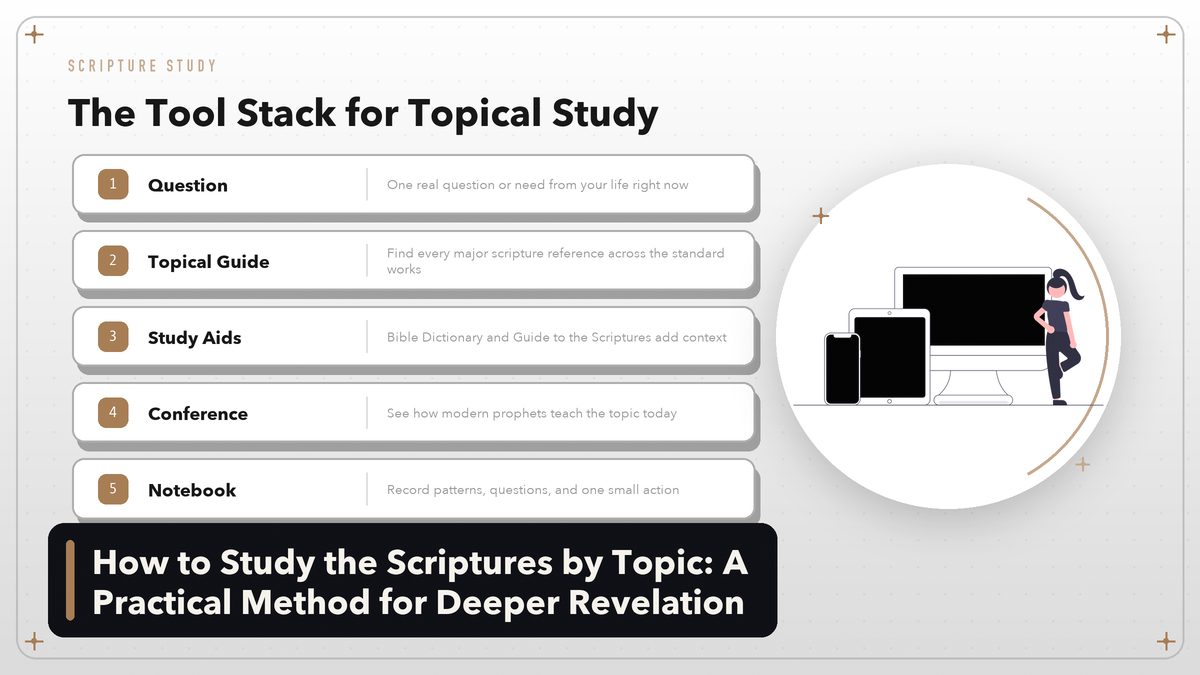
How to Study the Scriptures by Topic: A Practical Method for Deeper Revelation
Reading cover to cover is one way to know the scriptures. Studying by topic is how you let the scriptures know you—connecting scattered verses into patterns that answer real questions and illuminate real life.
A few years ago I found myself stuck on one word: patience. I wasn’t asking for grand spiritual experiences. I just needed to stop snapping at my kids over shoes left in the hallway. I opened the Topical Guide, looked up “patience,” and spent a week collecting every verse the index pointed to—verses from Job, from Alma’s counsel to his sons, from the Gospels, and from modern revelation. By day three, a pattern began to emerge. Patience, I realized, was less about white-knuckling my way through irritation and more about trusting God’s timing. The scriptures weren’t giving me a lecture. They were walking me somewhere.
That is exactly the kind of shift topical scripture study makes possible. Instead of moving through the text in the order it was written, you move through it in the order of your life, letting your questions set the pace. A question surfaces—about forgiveness, prayer, service, fear, or covenant keeping. You follow it across books, dispensations, and voices. Suddenly the Bible, the Book of Mormon, the Doctrine and Covenants, and the Pearl of Great Price are speaking to one another. Themes that seemed scattered start to form a chorus.
This approach isn’t new. The Church has spent decades building tools designed for exactly this kind of study: the Topical Guide in the standard works, the Bible Dictionary, the Guide to the Scriptures, and the searchable scriptures on ChurchofJesusChrist.org. All of them exist to help seekers trace a theme through the restored canon. When we use them intentionally, scripture study becomes less like checking a box and more like having a conversation.
Why Topical Study Changes the Way You Read
From information to a changed life
Most of us were taught to read the scriptures sequentially. Start at the very beginning of a book and keep moving forward. Chapter by chapter. Finish the whole thing. There’s real value in that rhythm: it builds context, introduces us to prophets as whole people, and keeps us from cherry-picking verses out of context. But sequential reading also has a limitation. It can keep our relationship with the scriptures at the level of information rather than change.
Topical study flips the script. You begin with a need, a curiosity, or a spiritual question, and you read with purpose. The same verse that felt like background noise during a cover-to-cover reading can become luminous when it answers something you’re actually asking. Meaning is relational. A verse doesn’t land differently because the verse changed. It lands differently because you did.
The scriptures themselves encourage this kind of searching, and they have done so for generations. The Lord invites us to “seek, and ye shall find; knock, and it shall be opened unto you.” Topical study is one way to knock with intention. It assumes the scriptures aren’t a museum to be toured but a house with many rooms, and that the Holy Ghost can guide us to the exact words we need across books and centuries.
Topical study assumes the scriptures are not a museum to be toured but a house with many rooms.
There’s also a practical benefit. Many Latter-day Saints want to study more but feel overwhelmed by the size of the canon. Starting with a topic narrows the field. Instead of wondering where to begin, you begin with what matters to you right now. One topic becomes a doorway into the whole library.
Choose a Topic That Matches Your Real Life
Start with a question, not a curriculum
The best topical studies don’t begin with “I should learn about faith.” They begin with something closer to “I keep saying I trust God, but I’m still anxious about money, health, and whether my kids will be okay.” The more personal the entry point, the more powerful the study.
Your topic can come from anywhere. Anything can spark it. A Come, Follow Me lesson might highlight a word you want to understand more deeply. A sacrament meeting talk might use a phrase that lingers in your mind. A difficult conversation, a parenting challenge, a moment of grief, or a hope for the future can all become invitations to study. Even a line from a hymn or a worry that keeps resurfacing on your commute can be enough to start.
Here are a few ways to identify a topic worth following:
- Follow the repetition. If a word, principle, or story keeps showing up in your reading, prayers, or conversations, pay attention. Repetition is often a spiritual nudge.
- Start with a feeling. Ask yourself what you are carrying right now. Gratitude, regret, loneliness, hope, fear, or longing can each point to a topic that the scriptures address with surprising specificity.
- Ask a gospel question. Questions like “What does it mean to be meek?” or “How does the Atonement actually change someone?” give your study structure and direction.
- Build on a conference talk. Choose a recent General Conference address and trace its central topic through the scriptures. This deepens your understanding of what the speaker was teaching.
Gather the Tools Before You Begin
Use the study aids the Church has already built
One of the biggest mistakes people make in topical study is trying to do it entirely from memory. They rely on the verses they already know and miss the verses they’ve never noticed. The Church has spent decades creating study aids precisely to prevent this. Using them isn’t cheating; it’s wisdom.
| Tool | Best for | How to start |
|---|---|---|
| Topical Guide | Finding every major scripture reference on a gospel topic across the standard works | Look up your word alphabetically, then follow the bold subtopics |
| Bible Dictionary | Understanding biblical words, people, places, and concepts in context | Read the full entry before studying related verses |
| Guide to the Scriptures | Short, cross-referenced overviews of gospel topics in all four standard works | Use it as a launchpad for deeper study |
| ChurchofJesusChrist.org search | Searching words, phrases, or entire passages across all scriptures and manuals | Use exact phrases in quotation marks for precise results |
| Conference talks | Seeing how modern prophets and apostles teach a topic today | Search the topic at the general conference archive |
You don’t need every tool for every study. If your topic is a single word like “repentance” or “charity,” the Topical Guide is usually the best place to start. If your topic is a concept like “grace” or “covenant,” the Bible Dictionary and Guide to the Scriptures can give you a framework before you look at the verses themselves. For seeing how the topic is taught today, General Conference addresses keep your study anchored in modern revelation.

The Five-Step Method That Keeps You Grounded
A repeatable process for any topic
Without a method, topical study can become a hunt for proof texts. You find the verse that supports what you already believe, feel a small spiritual buzz, and move on. That’s not study. That’s confirmation bias with a highlighter. A better process keeps you curious, grounded, and open to surprise.
1. Name your question clearly
Before you open any study aid, take a minute to write down what you are actually trying to understand, because clarity at the start saves confusion later. A clear question gives your study boundaries. “Tell me about faith” is too broad. “What does it mean to exercise faith when I cannot see the outcome?” is specific enough to guide your reading. Write it down.
2. Collect verses from multiple sources
Use the Topical Guide, Guide to the Scriptures, and the online search to gather references. Do not stop at the first few. Look for verses from the Old Testament, New Testament, Book of Mormon, Doctrine and Covenants, and Pearl of Great Price. The goal is breadth before depth.
3. Read each verse in context
This is the step that separates real study from verse collecting, and it is the step most people skip. Read carefully. Ask who is speaking, who is listening, and what is happening in the scene. A single verse about patience means one thing in isolation. It means something richer when you know the prophet is writing from prison or the Savior is speaking to grieving friends.
4. Look for patterns, not just answers
As you read across sources, watch for repeated words, contrasting examples, and unexpected connections that you would never see if you stayed in one book. Compare the Old Testament and the Book of Mormon. How does each teach patience? Does the Savior use the topic in parables, sermons, and personal interactions? Patterns matter. Patterns are where doctrine becomes understanding.
5. Record what you are learning
Write down the question you started with, the verses you read, the patterns you noticed, and the impressions that came. This is not busywork. Writing forces clarity. It also creates a record the Holy Ghost can use later to bring truths back to your mind at the exact moment you need them.
Patterns are where doctrine becomes understanding.
Read in Context, Even When You Are in a Hurry
The guardrail that keeps topical study honest
Every method has a weakness. For topical study, that weakness is context collapse. When you pull verses from many places, it’s easy to flatten their meaning. A command given to ancient Israel becomes a generic life lesson, while a promise made to one prophet becomes a blanket guarantee in our hands. The scriptures can speak to us personally. But they were also written to real people in real situations. Honoring both dimensions matters.
Context changes everything. Alma 32 lands differently when you remember Alma is speaking to poor Zoramites cast out of their synagogues. The Beatitudes change shape when you picture the Savior teaching on a hillside to people living under Roman occupation. The setting is not decoration. It is part of the message, not an optional detail.
The best topical readers ask three questions of every verse:
- What did it mean then? Understand the historical and textual setting. Who wrote it? To whom? Under what circumstances?
- What does it mean now? Look for the timeless principle. What does this teach about God, Christ, the plan of salvation, or how to live?
- What does it mean for me? Invite the Holy Ghost to show you how this truth applies to your specific circumstances.
This three-layer reading protects you from two common errors: treating the scriptures as dead history, or treating them as a collection of motivational quotes. They are neither. They are words from a living God, delivered through prophets, to people like us. Topical study works best when all three layers are honored.
Let the Study Change Your Prayers
From reading about God to speaking with him
There is a subtle but important difference between studying a topic and studying with the Spirit. The first is an intellectual exercise; the second is a devotional one. Both have value. Only the second changes the heart.
As you gather verses, pause often to pray about what you are reading. Ask the Lord what he wants you to see in the verses you have gathered, and then wait long enough to hear an answer. Sometimes the answer is a clearer understanding of doctrine. Sometimes it is a specific prompt to act, forgive, serve, or repent. Sometimes it is simply a feeling of peace that reminds you God is aware of you and that you are not walking through your question alone.
Prayer also keeps your study humble. It reminds you that you’re not mining the scriptures for ammunition in an argument or for a clever social media post you can share later. You’re seeking the mind and will of God, and that posture makes all the difference.
Turn Insights Into Action, Not Just Notes
The point of study is a changed life
The scriptures were never meant to be a private academic project for us to complete alone. They were meant to shape how we think, speak, treat one another, and follow the Savior in the ordinary, overlooked moments of daily life. If a topical study doesn’t eventually lead to a changed action, it hasn’t finished its work. Keep Christ central.
This doesn’t mean every session needs a dramatic commitment. Often the action is small: speak more gently to your children, pray more specifically about your worries, trust more quietly when the answer is slow, serve more quickly when you see a need. Start with something small. The point is to translate insight into behavior while the insight is still warm.

One practical way to close every study session is to finish this sentence: “Because of what I read today, I will…” It might be “I will apologize to my sister,” “I will start my day with prayer,” or “I will stop rehearsing that worry in my mind.” Small actions keep study from becoming sterile.
Common Pitfalls and How to Avoid Them
Keep your study healthy and honest
Even with a good method, topical study can go sideways. Knowing the common traps helps you avoid them.
- Trying to cover too much. A week on “charity” is better than a day on “every Christlike attribute.” Pick one focus and stay with it.
- Ignoring verses that do not fit. If a verse complicates your tidy conclusion, sit with it. The scriptures are not always simple, and that is part of their power.
- Forgetting to study the Savior. Almost every gospel topic eventually points to Jesus Christ. If your study of any topic does not lead you to him, keep going.
- Replacing sequential reading entirely. Topical study is a complement, not a replacement. Continue your Come, Follow Me reading and other sequential study alongside it.
- Waiting until you “have time.” Fifteen focused minutes of topical study is more valuable than an unfocused hour you keep postponing.
If your study of any topic does not lead you to Jesus Christ, keep going.
Start Where You Are
One small step into topical study
You don’t need a theology degree, a massive library, or a perfectly quiet house to study the scriptures by topic, because the Lord meets us wherever we happen to be. You need a question, a tool, and a willingness to be taught. The Lord has promised that those who ask, seek, and knock will receive. That promise is for anyone who asks.
So start today. Open the Topical Guide or the online search, pick one word that matters to your life right now, and read five verses about it. Write down anything you notice, even if it seems small. Pray about it. Choose one small action. That’s not a lesser form of scripture study. That’s exactly how faith grows—one question, one verse, one obedient step at a time.
The scriptures have always been alive to those who take them seriously. Topical study is simply one of the best ways to let them speak into the messy, beautiful circumstances of your life. The Lord knows what you need. Often, he is waiting for you to ask.
Sources and related reads: This article references the Topical Guide, Bible Dictionary, Guide to the Scriptures, the Church’s scriptures archive, Come, Follow Me, and General Conference addresses. For more practical study help, see our articles on building a daily scripture habit, scripture journaling methods, and a beginner’s Book of Mormon reading plan.