How to Be a Better Sunday School Teacher: A Simple Prep Method
Teaching a gospel class is less about having all the answers and more about helping people feel safe enough to ask real questions. A calm, repeatable prep method makes that possible.
I still remember the Sunday I walked into the Gospel Doctrine classroom with a stack of printed conference talks, three different colored highlighters, and no plan at all. The lesson manual sat on the kitchen counter at home. For forty-five minutes I talked—mostly at the class—while a few kind souls nodded and the rest politely checked their phones. On the drive home my wife said, gently, “You know, you don’t have to cover everything.” She was right. The problem wasn’t a lack of material. I had prepared like someone trying to win a theology debate instead of someone inviting a roomful of Saints to meet Christ.
That experience changed how I think about Sunday School. The Savior’s way of teaching was almost never a monologue. He asked questions, told stories, used objects people already knew, and then let the Spirit do the converting. Teaching in the Savior’s Way puts it plainly: our purpose is to help others become converted to the gospel of Jesus Christ. Conversion rarely happens because someone heard a flawless lecture. It happens when a learner feels the Holy Ghost confirming truth in a moment of honest reflection.
So this article is for the teacher doing their best on a busy Saturday night, the longtime teacher whose class has gone flat, and the brand-new teacher terrified of silence. I want to share the prep method I eventually settled on: a simple five-day rhythm that turns lesson preparation from a frantic search for something to say into a quiet invitation to learn together.
Start With the People, Not the Lesson
The first question is always about love
Before I open a manual or look up a single scripture, I picture the actual people who will be in the chairs. Someone is grieving. Someone just got released from a demanding calling and is relieved, or sad, or both. A teenager is trying to survive the cultural whiplash of high school. A young adult is wondering if the Church has a place for them anymore. An older member has heard this lesson twelve times and needs to be surprised by it.
This sounds obvious, but it is easy to skip. Starting with the outline treats the class like an audience waiting to receive information. Starting with the people treats them like fellow travelers who have brought their whole lives into the room. President Henry B. Eyring taught that a gospel teacher should pray to know the needs of the learners before preparing the lesson. That prayer reminds you that you are not the performer; you are the host.
I keep a small note card in my scriptures with the first names of regular class members. On Saturday evening I look at the list and ask which one person might need the principle we are studying. Not in a manipulative way—just as a way to keep the lesson human. Some weeks the person who comes to mind is me. That is fine too. The best lessons I have taught were the ones I needed to hear first.
The Five-Day Prep Flow
A little each day beats one frantic night
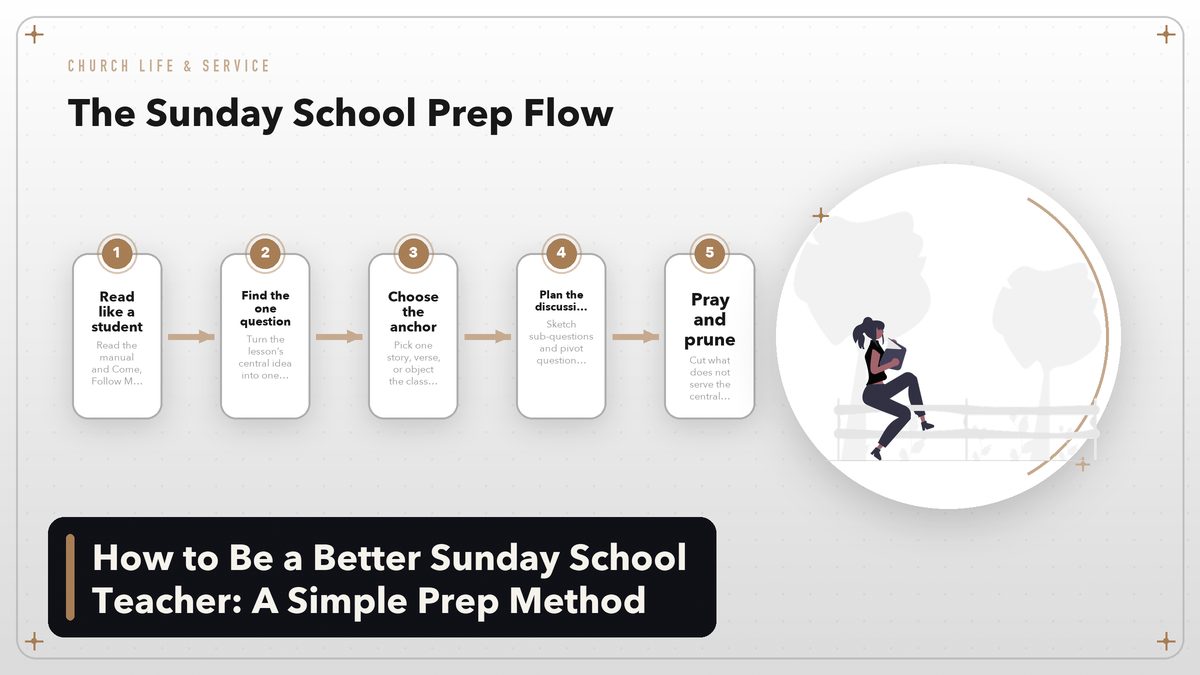
My method spreads the work across five days, with each day carrying one clear job. If your week explodes—which happens—you can compress days four and five into Saturday, but the rhythm matters more than the calendar. The point is to give the lesson time to sit with you so that by Sunday you are no longer reading notes; you are sharing something that has already begun to change you.
Day 1: Read the lesson like a student
On Monday or Tuesday I read the assigned Come, Follow Me segment or the Sunday School manual chapter without a pen in my hand. I am not hunting for a clever insight yet. I am trying to notice what stands out. Sometimes a verse feels unusually bright. Sometimes a question from the manual lodges in my chest and will not leave. Sometimes I realize I have misunderstood a story my whole life.
This first read is also when I look at official Church resources. The Come, Follow Me home-study materials are written for individuals and families, which means they are already designed to spark personal application. The Sunday School manual adds teaching ideas, discussion questions, and historical context. I also keep the Gospel Library app open to the Bible Dictionary and Guide to the Scriptures, because one clear definition can keep a class from getting lost in a difficult word. I read all of it slowly, because the lesson improves when I let the Church’s curriculum do part of the thinking for me.
Day 2: Find the one question
By Wednesday I force myself to finish this sentence: “If my class remembers only one thing, I want it to be __________.” Then I turn that into one open-ended question. Not yes-or-no. Not trivia. A question that invites people to bring their own experience into the room.
For a lesson on faith, the question might be, “When has a small act of obedience led to something bigger than you expected?” For repentance, it might be, “What does the Savior’s invitation to ‘come unto me’ actually sound like in your life right now?” The question goes at the top of my notes in bold. Every other activity, story, or scripture must serve it.
Having one central question saves you from trying to cover every angle. The New Testament is not going anywhere. Your job is not to summarize it. Your job is to help people encounter it.
Day 3: Choose the one story or verse
On Thursday I pick one story, one verse, or one concrete example that anchors the lesson. Humans remember specifics, not abstractions. Jesus did not say, “Be compassionate in general.” He told the story of the Good Samaritan. He did not lecture about faith. He invited Peter to walk on water, fail, and be caught.
I usually turn to the scriptures first. The Savior’s visit to the Nephites in 3 Nephi 11 is a masterclass in teaching: he introduces himself, invites the people to feel his wounds, and patiently explains doctrine through question and answer. When I am stuck, I read that chapter and ask what Jesus would do differently if he were standing at the front of my classroom.
If the lesson is not scripture-heavy, I use a personal story, a historical account from a conference talk, or an object from the room. One of the best teachers I know once brought a tangled extension cord to class to illustrate repentance. We still talk about it.
Day 4: Plan the discussion
By Friday I sketch the actual flow of the class. I write three to five sub-questions that lead toward the central question. I think about how long each section should take. I decide whether to start with a story, a question, a silent reading, or a short clip from General Conference.
Here is the secret: plan more discussion than lecture. A healthy Sunday School class probably needs no more than ten to fifteen minutes of direct teaching from the instructor. The rest should be the class wrestling with ideas together. If you find yourself writing page after page of things you want to say, that is a warning sign. Cut it in half, then cut it again.
I also plan two or three “pivot questions” in case the discussion stalls. Simple prompts like, “What word in this verse stands out to you?” or “How would you explain this to a new convert?” give you somewhere to go when the silence stretches.
Day 5: Pray and prune
On Saturday I read through everything I have prepared and remove whatever does not serve the central question. This is the hardest step because almost everything feels worthwhile. But a lesson crammed with good ideas is usually a lesson with no single clear idea. I ask the Lord what to keep and what to set aside. Sometimes the thing I am most attached to is the very thing that needs to go.
Then I pray to love my class. Not to perform well. Not to be clever. To love them. That prayer does more for the lesson than any commentary I could look up.

Three Ways to Teach, and When to Use Each
Match the method to the moment
Not every part of a lesson needs the same approach. Over the years I have found that most effective classes move between three modes: brief instruction, guided discussion, and participatory activity. Knowing when to use each keeps the energy from flattening out.
| Method | Best for | Watch out for |
|---|---|---|
| Brief instruction | Introducing context, correcting common misunderstandings, or summarizing a doctrine clearly. | Turning the whole class into a lecture. Keep it under ten minutes. |
| Guided discussion | Helping learners discover principles themselves and share testimony. | Letting one person dominate. Gently redirect to the room. |
| Participatory activity | Kinesthetic learners, families with children, or complex processes like family history. | Making the activity feel like a craft project with no gospel point. |
The Savior moved fluidly between these. In the New Testament he teaches by direct statement (“Blessed are the poor in spirit”), by question (“Whom do men say that I am?”), and by embodied action (washing the disciples’ feet). A good Sunday School class does the same. If your class has been sitting still for ten minutes, it is probably time for them to talk or do something.
The best teaching moments rarely come from the teacher’s mouth. They come from the quiet space between the question and the first brave answer.
The Sunday Morning Flow
Arrive early, start softly, end on time
No matter how well I prepare during the week, Sunday morning has its own rhythm. I try to arrive at least fifteen minutes early. That gives me time to arrange chairs in a rough circle, check the audio if I am using a video, and greet people as they come in. The way people feel when they walk through the door shapes the whole hour.
I start class with a short, low-stakes question or activity. Something like, “Turn to someone near you and share one word that describes your week.” It sounds small, but it wakes the room up and reminds everyone that this is a conversation, not a broadcast. Then I state the central question for the day and tell them where we are headed. People listen better when they know the destination.
During the lesson I keep one eye on the clock and one eye on the people. If the discussion takes off in an unexpected but fruitful direction, I follow it for a while before steering back. If someone asks a question I cannot answer, I say so honestly. “I don’t know, but I would love to study that with you” is one of the most respectable things a teacher can say. It models humility and invites the class to keep searching.
Mixed-age classes are the norm in many wards, which means I may have a twelve-year-old sitting next to a grandparent. I try to phrase questions so both can answer. Instead of asking, “What did the pioneers teach us about faith?” I might ask, “When have you had to keep going even when you could not see the end?” The first question invites one kind of knowledge; the second invites experience, and experience is something every age has.
I end five minutes before the hour. The last few minutes belong to testimony. I ask someone—or offer myself—to share a brief, simple testimony of the principle we studied. Then I close in prayer and thank people for coming. Walking out on time is a kindness to the next class and to the families who need to get to sacrament meeting.

When Class Goes Sideways
Every teacher needs a few recovery moves
Even with great preparation, some Sundays go sideways. A controversial comment hijacks the discussion. The technology fails. Only three people show up. Someone starts crying and you are not sure why. These moments are not failures of preparation; they are part of teaching real people.
When a comment pulls the class off course, I try to acknowledge the person’s sincerity while redirecting. “That is an important question, and it might be worth a one-on-one conversation after class. For now, let’s look at what the manual invites us to focus on.” This honors the person without letting the whole class derail.
When technology fails, I have a paper backup. A printed scripture or a story I can tell from memory keeps the class moving. When attendance is low, I treat the small group as a gift rather than a disappointment. Some of the richest gospel conversations I have had happened with four people around a table.
And when someone becomes emotional, the best response is often silence. Do not rush to fill it. Let the Spirit do what only the Spirit can do. Your job is to be present, not to perform presence.

Start Where You Are
One small change this week
If you take nothing else from this article, take this: you do not need a seminary degree, a perfect voice, or a flawless lesson plan to be a good Sunday School teacher. You need a willing heart, a little preparation, and enough humility to get out of the Spirit’s way. Doctrine and Covenants reminds us that the Spirit is the real teacher. “The Spirit shall be given unto you by the prayer of faith,” it says, and if we receive it, we are empowered to teach one another the doctrine of the kingdom.
So start where you are. If your prep is usually Saturday night panic, try spending fifteen minutes on Wednesday finding the one question. If your class is mostly lecture, plan one discussion question and sit with the silence until someone answers. If you have been teaching for years and feel burned out, ask the Lord to help you love one specific person in your class this week.
Teaching is a form of discipleship. Every time you open the scriptures with your brothers and sisters, you are doing something Jesus spent his mortal ministry doing. That is worth the effort. That is worth the awkward moments. That is worth showing up for, even when you feel unprepared—especially then.
Related reads on LDS Voices: How to Strengthen Your Testimony One Small Step at a Time, How to Recognize the Holy Ghost in Everyday Life, and How to Study the Scriptures by Topic. External sources: Teaching in the Savior’s Way, Come, Follow Me, 3 Nephi 11, and General Conference.