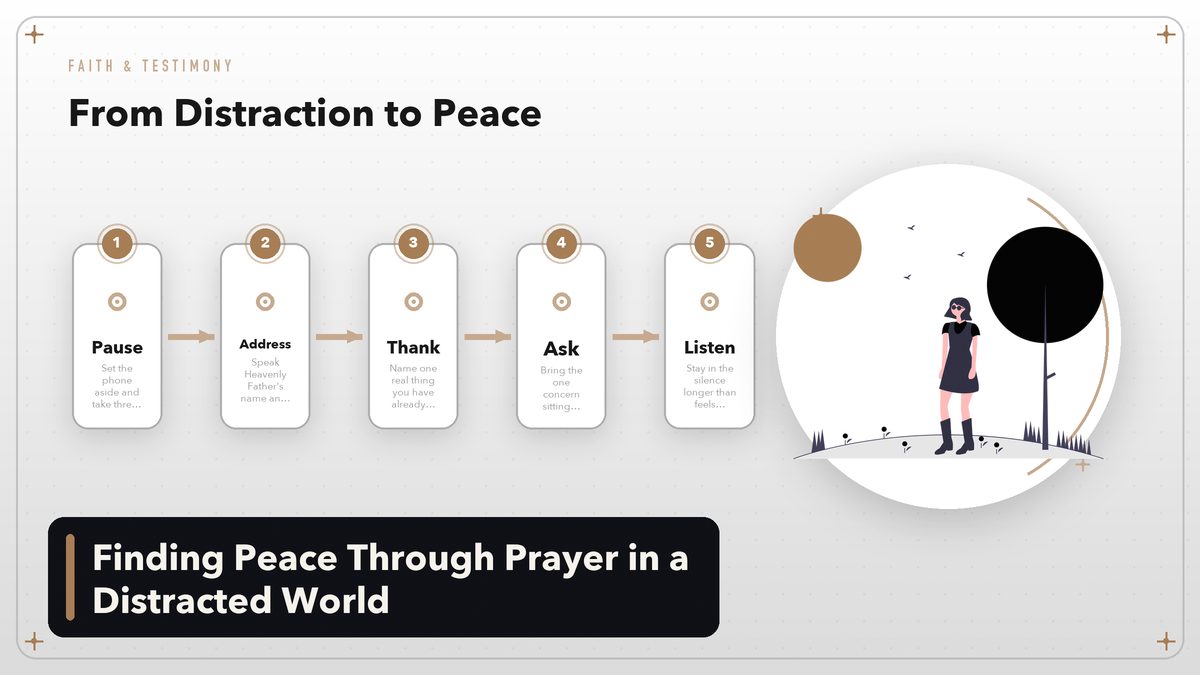
Finding Peace Through Prayer in a Distracted World
Prayer was never meant to be another task on a crowded list. It’s the quiet door through which peace enters, even when the rest of life keeps pinging.
I was sitting in the church parking lot with my phone in my lap when I realized I’d forgotten how to be still. Engine off, keys in hand, a dozen notifications sitting between me and the chapel doors. I’d driven there early, on purpose, hoping for five quiet minutes before the meeting started. I scrolled a group chat and answered an email I’d already answered twice. Then I watched a video I didn’t care about. By the time I walked inside, my mind felt like a browser with thirty tabs open. I bowed my head for the opening prayer and couldn’t remember what I’d wanted to say to God.
That small failure stuck with me longer than I expected. Nothing dramatic. Nobody else noticed. But it exposed something I’d been ignoring: my prayers had become background noise in a life already full of background noise. I was talking to God while mentally sorting grocery lists, replaying conversations, and planning replies. The words were there. The attention wasn’t.
Prayer isn’t complicated, but it does require presence. The Church’s Gospel Topics essay describes prayer as the act by which the will of the Father and the will of the child are brought into correspondence with each other (Gospel Topics: Prayer). Correspondence is a gentle word. It suggests a real exchange, not a monologue shouted into a busy room. When we pray with divided attention, we miss the correspondence.
The Distraction Problem Is Not New
It’s tempting to blame smartphones for everything, but the human mind has always wandered. The scriptures are full of people who struggled to stay focused on God. Martha worried about many things while Mary sat at the Savior’s feet. The disciples fell asleep in Gethsemane when they’d been asked to watch. The ancient Nephites were warned against vain repetitions and the use of many words (3 Nephi 13:7-8). Distraction is an old companion. Our phones just make it louder and more colorful.
The real problem isn’t the devices themselves. It’s the way they train us to crave novelty. Every swipe delivers something new. Every notification promises a small reward. Prayer, by contrast, often feels like the same thing every day. We thank, we ask, we close. The ritual can start to feel flat, especially when nothing obvious changes. So we drift. We check the time. We think about what comes next. We treat prayer like a pause between activities rather than the activity itself.
President Russell M. Nelson taught that in the commotion of our modern world, we need to find ways to hear the voice of the Lord more clearly (President Nelson, “Hear Him,” October 2020 general conference). That phrase, “hear Him,” is the goal. Distraction makes hearing almost impossible. Peace begins when we turn the volume down on everything else long enough to notice what God has already been saying.
The goal of prayer isn’t to get through a list of requests. It’s to be present long enough to hear.
What Prayer Actually Looks Like
A conversation, not a performance
Many of us carry an unspoken script for prayer. We feel we should sound reverent, cover certain topics, and avoid repetition. We kneel, fold our arms, close our eyes, and deliver a short spiritual report. Nothing wrong with the posture. But when the form becomes the whole point, prayer turns into a performance we give for an audience of one, hoping we measured up.
The Savior gave a different pattern. In what we often call the Lord’s Prayer, He showed His disciples how to address God simply and directly: Our Father, Thy kingdom come, Thy will be done, give us our daily bread, forgive us, help us forgive others, lead us away from temptation (3 Nephi 13:9-13). The prayer is short. It’s honest. It moves from praise to need to protection. No flowery language, no attempt to impress.
Elder Cordon taught in general conference that prayer is not a last resort but the first response of a faithful heart (Elder Cordon, “Pray Always,” October 2019 general conference). That reframing changes the day. Prayer becomes the place we go before we try to fix things ourselves. It becomes the steady background of a life oriented toward God, not the emergency button we press when everything else fails.
Some of the best prayers are also the shortest. A single sentence of gratitude before a meeting starts. A whispered request for patience while a toddler melts down. A moment of silence after reading a verse that cuts straight to the heart. These prayers don’t replace longer, deliberate prayer, but they extend it into the ordinary hours where most of life actually happens.
The Anatomy of a Peaceful Prayer
Four parts that turn noise into stillness
Peace in prayer doesn’t usually arrive all at once. It grows as we put a few simple pieces in place. Think of them as the anatomy of a prayer that actually settles the mind rather than stirring it up. Each part can be brief. Together they create room for God.

Address God directly
Start with the simple fact of relationship. Heavenly Father isn’t a distant force. He’s a parent. Using His name, even quietly, reorients the heart. The True to the Faith booklet explains that we pray to our Heavenly Father in the name of Jesus Christ (True to the Faith: Prayer). That pattern matters. It reminds us who we’re talking to and who makes the conversation possible.
Express gratitude before asking
Gratitude is the fastest way out of anxiety. When we begin by naming what we’ve already received, our perspective shifts. The problems don’t disappear, but they stop occupying the entire stage. A grateful heart is also a more honest heart. It keeps our requests from becoming demands.
Ask honestly
God doesn’t need polished language. He needs the truth. Tell Him what you actually feel, including the parts that are messy, doubtful, or angry. The scriptures show prophets pouring out frustration, fear, and confusion to God. That kind of honesty isn’t disrespectful. It’s trust. You don’t hide from someone you believe loves you.
Listen longer than you speak
This is the hardest part for most of us. We’re used to talking and then moving on. Prayer requires the opposite. After the words stop, stay still. Let the silence do its work. The Holy Ghost often speaks in a voice that feels like a thought, a feeling of peace, or a sudden clarity about what to do next. If we fill every gap with our own words, we leave no room for that quiet voice.
A Simple Daily Pattern
Most people don’t need a more complicated prayer life. They need a more consistent one. The good news is that consistency doesn’t require hours. It needs a repeatable shape that fits real life. The following pattern isn’t the only way to pray, but it’s a reliable one.

Begin by removing one distraction. Put the phone in another room, close the laptop, or just turn off the radio. You don’t need a monastery. You need a signal to your brain that this moment is different. Then take three slow breaths. The body often leads the spirit. When your breathing slows, your thoughts tend to follow.
Next, speak God’s name and one thing you’re grateful for. Don’t make a list of twenty. One real thing is enough. Then bring one concern. Not every problem in your life. The one sitting heaviest right now. Name it plainly. Ask for what you need. Finally, sit in silence for a minute or two. Set a timer if you have to. The point is to stay longer than feels comfortable, because the discomfort is usually the noise leaving.
When Distraction Wins Anyway
Some days the mind won’t settle. You close your eyes and immediately remember an email, a bill, a conversation, a worry. That’s normal. The question is what to do next. The decision matters more than the distraction.

When you notice your attention has drifted, you have three options. You can judge yourself and quit, deciding you’re just not good at prayer. You can fight the thought and try to bury it. Or you can name the distraction briefly, hand it to God, and return to your prayer. The third option is the only one that works long term. Every return is a small act of faith.
There’s a difference between a distracted prayer and a prayer offered in distraction. A distracted prayer is one where we never really showed up. A prayer offered in distraction is one where we keep showing up even though our thoughts scatter. The second kind is far more common in real life, and God meets us there. The Bible Dictionary notes that the object of prayer is not to change the will of God but to secure for ourselves and for others blessings that God is already willing to grant but that are made conditional on our asking (Bible Dictionary: Prayer). That means the asking itself is part of the blessing. Even distracted asking counts.
Some people find it helps to write their prayers. Others pace or pray aloud. A few keep a small notebook nearby to jot down the intrusive thought so the brain can let go of it. These aren’t spiritual shortcuts. They’re ways of honoring the fact that you’re a body as well as a spirit, and bodies have habits.
When You Don’t Know What to Say
There are days when prayer feels like staring at a blank page. You know you should pray. You even want to. But the words feel thin, rehearsed, or absent altogether. I’ve sat on the edge of my bed at night with my hands folded and nothing to offer except the vague sense that I ought to try harder. Those are not failures. They are invitations to a different kind of prayer.
Sometimes the most honest prayer is silence. Just showing up, naming the silence, and waiting. “Heavenly Father, I’m here. I don’t have words tonight.” That counts. In fact, it may count more than a long, fluent prayer offered without real attention. God already knows what we need before we ask. The asking is for us. It shapes us. It opens us.
On the days when words fail, I sometimes borrow other people’s. The Psalms are full of prayers for people who don’t know what to say. “Lord, how long wilt thou forget me?” isn’t pretty, but it’s real (Psalm 13). A hymn can become a prayer when you sing it slowly enough to mean it. The sacrament prayers, repeated every week, carry centuries of longing in a few sentences. Leaning on these words isn’t cheating. It’s how generations of believers have kept the conversation going when their own vocabulary ran out.
I’ve also learned to pray with my body when my mind won’t cooperate. Walking the same loop around the neighborhood. Kneeling even when it feels awkward. Holding a simple object, a stone or a key or a photograph, as a physical reminder of what I’m bringing to God. The body remembers devotion even when the mind forgets.
The silence doesn’t mean God is absent. It usually means He is giving us room. Room to feel what we actually feel. Room to let go of the performance. Room to arrive at prayer as ourselves instead of as the polished version we think God wants. The psalmist understood this. So did the prophets. Real prayer has always made room for honesty, even when honesty sounds like nothing at all.
Turning Ordinary Moments Into Prayer
Formal prayer is essential, but it’s not the only kind. The Apostle Paul told the Thessalonians to pray without ceasing (Bible Dictionary: Prayer). That doesn’t mean we spend every waking hour on our knees. It means we keep the line open. We turn ordinary moments into brief correspondences with God.
Walking to the car after work can become a prayer of thanks for making it through the day. Washing dishes can become a prayer for a child who’s struggling. A red light can become a moment to breathe and invite the Spirit. These small prayers don’t replace morning or evening devotion. They extend it. They teach us that God isn’t confined to a ritual time slot.
The distractions won’t go away. The world is loud, and it’s getting louder. But peace isn’t the absence of noise. It’s the presence of God in the middle of it. Prayer is how we practice noticing that presence. Each time we choose attention over distraction, even for a few seconds, we strengthen our capacity to hear Him. That capacity grows slowly, almost imperceptibly, until one ordinary day you realize your heart is calmer than it used to be.
Peace isn’t the absence of noise. It’s the presence of God noticed in the middle of it.
What to Expect When You Stay With It
Prayer doesn’t always produce immediate feelings. Some days it’ll feel flat. Other days it’ll feel like coming home. Both kinds of days matter. The value of prayer isn’t measured by how spiritual we feel afterward. It’s measured by whether we keep returning to the Source of all peace.
Over time, a regular prayer life begins to change the inner atmosphere. Worries lose some of their urgency because they’ve been handed over. Decisions become clearer because they’ve been brought into the light. Gratitude becomes more natural because we’ve practiced naming blessings. We start to notice God’s hand in places we used to rush past.
If you’ve been struggling to pray, start smaller than you think you should. One honest sentence is enough to open the door. If you’ve been praying for years and it’s started to feel mechanical, shake up the shape. Pray in a new place, at a new time, or about something you’ve been avoiding. Try speaking your prayer aloud, or writing it in a notebook, or praying while you walk. The form isn’t sacred. The connection is. The goal isn’t to perfect the form. The goal is to keep the correspondence alive.
For more on building spiritual habits, see our articles on daily scripture study, strengthening testimony, and personal journal keeping.