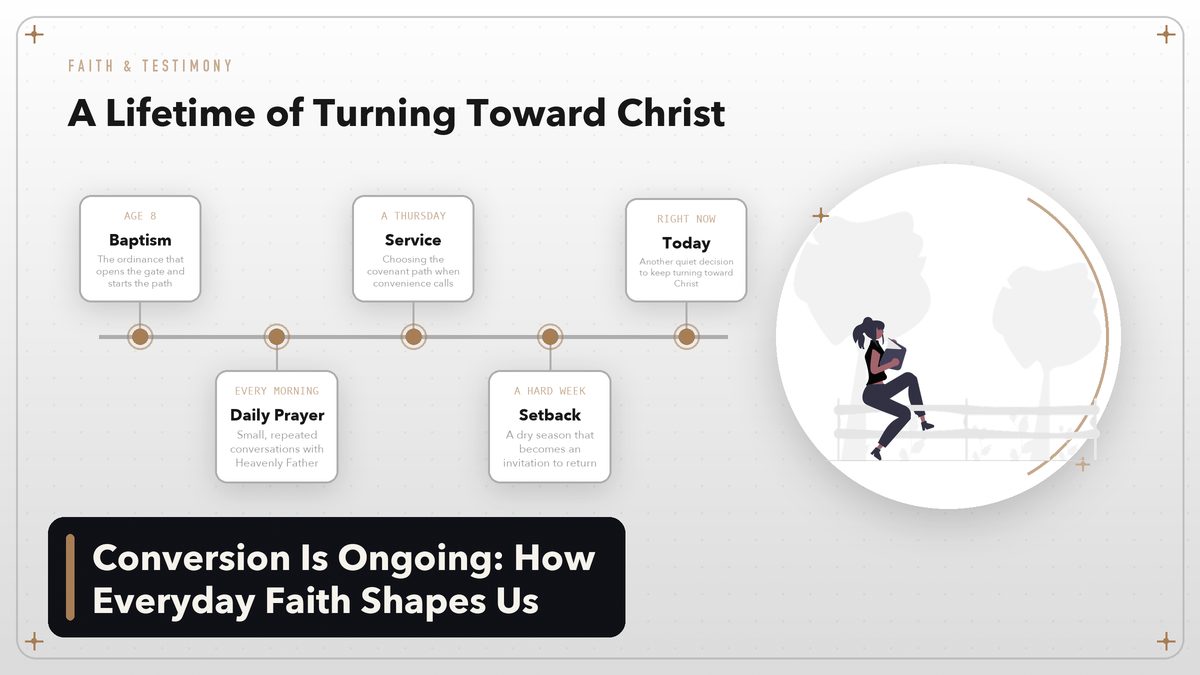
Conversion Is Ongoing: How Everyday Faith Shapes Us
Conversion is not a single moment we arrive at once and then display on a shelf. It is the quiet, repeating choice to keep turning toward Jesus Christ in the middle of ordinary days.
A few years ago I sat near the back of a sacrament meeting and listened to a man in his sixties bear his testimony about the day he was baptized. He described the water, the hands on his head, the unmistakable warmth he felt when he came up out of the font. Then he said something that stayed with me: “I thought that was the finish line. It turned out to be the starting block.” The room laughed, but I recognized the feeling. I had spent too long treating my own conversion like a diploma I had already earned, something I could frame and forget.
The truth is messier. And, honestly, more comforting. Conversion is not a certificate. It is a direction. The Book of Mormon shows this again and again. Alma the Younger did not wake up from his angelic rebuke fully formed; he spent years preaching, repenting, and “wading through much tribulation” before he could say his people had been converted unto the Lord. If one of the greatest missionaries in scripture needed a process, the rest of us can give ourselves permission to need one too.
What I want to do here is loosen the grip of the finish-line idea. Conversion is not a badge you wear. It is the shape your life takes when you keep choosing Christ after the feeling has faded, after the meeting ends, after the prayer does not seem to go anywhere. The good news is that ordinary life gives us plenty of chances to practice that choice. Most of them arrive without fanfare.
Why We Keep Confusing Conversion With a One-Time Event
Some of the confusion comes from how we talk. We say someone “got converted” the way we say they got married or got a degree, as if conversion were an event that happens and then belongs to the past. Baptism and confirmation are real events, of course, and they matter. They are the ordinances that open the gate, as Nephi taught, the moment we enter the path that leads to eternal life. But entering a path is not the same as finishing the walk.
Elder David A. Bednar made this distinction with unusual clarity in his April 2012 general conference address. Testimony, he explained, is knowledge and spiritual conviction. Conversion is the conscious choice to do what we know is right. A testimony can arrive in a flash. Conversion, he said, is “a process, not an event.” That one sentence rearranged how I thought about my own spiritual life. I had plenty of testimony moments. What I needed were conversion habits.
Intensity confuses us too. A powerful spiritual experience feels like conversion because it is unmistakable. But intensity fades, and when it does we can mistake the fading for backsliding. Real conversion is what remains after the intensity cools. It is the choice to pray when prayer feels mechanical, to read scripture when the verses seem flat, to attend sacrament meeting when the pew is hard and the toddler is louder than the speaker.
What Everyday Conversion Actually Looks Like
Everyday conversion is small. That is the whole point. It is the decision to get out of bed ten minutes early so you can read a chapter of the Book of Mormon before the house wakes up. It is pausing in the grocery-store parking lot to ask Heavenly Father to help you be patient with the child who is about to melt down over cereal. It is sending the text to the person you have been avoiding because the Spirit nudged you to make peace.
These moments do not look dramatic from the outside. They rarely feel dramatic from the inside. But they are the fabric of a converted life. The Savior’s ministry was made of small encounters: a woman at a well, a blind man on a roadside, a child brought to his lap. He did not wait for a stage. He kept turning toward the person in front of him. Everyday conversion asks us to do the same.

In my own life, conversion usually shows up as a choice between convenience and covenant. Covenant keeping is rarely the easier option in the moment. It is easier to scroll than to study. It is easier to stay home than to visit a neighbor. It is easier to nurse a grudge than to apologize. Every time I choose the covenant path when the convenient path is open, something in me shifts. The shift is small, but shifts repeated over years change the shape of a soul.
Last winter I had a week where every spiritual practice felt like a chore. I read my scriptures because I had read them the day before, not because I wanted to. I prayed because it was bedtime. Then on a Thursday, a neighbor I barely knew texted to ask if someone could drive her to a doctor’s appointment. Nothing about the request felt spiritual. It was cold, I was busy, and I had a long list of reasons to say no. I went anyway. The conversation in the car was ordinary — her grandchildren, the price of heating oil, whether the bishopric would reorganize the Relief Society soon. When I got home, something had loosened. I had not had a revelation. I had simply chosen the covenant path when the convenient path was wide open. That is conversion on a Thursday.
The Role of Study, Prayer, and the Ordinary Means of Grace
Study and prayer are not spiritual bonus activities. They are the ordinary means by which conversion deepens. The Church’s Come, Follow Me curriculum is built on this assumption: regular, unhurried contact with scripture and Spirit is what changes us. Not once. Repeatedly.
I used to treat scripture study like a vitamin I had to swallow before I could get on with my day. Check the box, move on. That approach produced exactly what you would expect: thin, dutiful faith. The change came when I stopped trying to extract a lesson from every chapter and started letting the text simply be present in my mind. Some days I underlined nothing. Some days a single phrase sat with me for hours. Both kinds of days counted, because both kept me in contact with the word.
Prayer works the same way. The Lord’s Prayer gives us a shape, not a quota. We address our Father, acknowledge his holiness, ask for daily bread, seek forgiveness and offer it, ask for help against temptation, and close in the name of Christ. That shape is meant to be repeated until it becomes the shape of our hearts. Prayer, practiced honestly, slowly rewires what we want and what we fear.
The ordinances and covenants are not the end of the journey; they are the steadying rails that keep the journey pointed toward Christ.
There is a difference, I think, between studying to know and studying to become. The first wants information. The second wants formation. Both are good, but conversion belongs to the second. When I read the Book of Mormon asking “What should I do differently today?” instead of “What should I remember for trivia?” the same verses hit differently. They stop being museum pieces and start becoming invitations.
Why Setbacks Do Not Mean You Are Starting Over
If conversion is a process, then setbacks are part of the process. That sounds like a comforting platitude until you are actually in one. Then it becomes a lifeline. I have had stretches where my scripture study evaporated, where prayer felt like talking into a pillow, where I sat in church wondering whether any of it was true anymore. Those stretches did not mean my conversion had disappeared. They meant I was at a rough mile on a long road.
The Book of Mormon is crowded with people who stumbled while they were trying to follow God. Alma’s people at the waters of Mormon were “in the gall of bitterness” before they were “born of God.” The sons of Mosiah had to “fast much and pray much” before they were qualified to preach. Even the faithful had to “wax stronger and stronger in their humility.” The scriptural pattern is not a straight ascent. It is a line that trends upward through repeated failure and recovery.

This is why repentance is not an emergency brake for the worst moments. It is the daily maintenance of a converted life. The doctrine of repentance is not primarily about punishment; it is about returning. Every time we turn back toward Christ, we are practicing conversion. The turning back is conversion.
I used to think repentance meant feeling bad enough about something that God would finally forgive me. That is a small view of a large gift. Repentance is the mechanism by which we keep moving. It is not a detour from the path; it is how the path handles traffic. The sooner I return, the sooner I am moving again. The longer I wait, the more I convince myself that I need to feel worthy before I come back, which is exactly the opposite of the point.
How Community Keeps Conversion From Becoming Private
Faith can feel intensely private, and some of it should be. But conversion is not meant to be a solo project. We are baptized into a ward, not just into a belief. We take the sacrament beside people we did not choose, which is itself a spiritual discipline. The person who sings off-key behind you, the teenager who sighs through the hymn, the elderly sister who always asks for your help with her walker — these are not obstacles to your worship. They are part of the curriculum.
Ministering, callings, and simple Sabbath fellowship all serve the same purpose. They keep conversion from shrinking into a feeling and stretch it into a way of relating. When I serve someone I find difficult, I am forced to rely on grace instead of affinity. That reliance is conversion. When someone serves me in a moment of need, I glimpse the Christlike love I am trying to believe in. That glimpse is conversion too.
The early Saints called each other brother and sister with awkward earnestness. The language has softened over time, but the reality remains. We really are siblings in the covenant, which means our conversion is partly each other’s business. Not in a nosy way. In a “I noticed you were missing and I missed you” way. In a “Can I sit with you?” way. Those small contacts are not interruptions to our spiritual life. They are one of the main ways God keeps us converted.
Practical Ways to Keep Moving Forward
None of this needs to be dramatic. In fact, it works better when it is not. Here are a few patterns that have helped me and others I trust keep conversion moving on ordinary days.
Start with whichever one feels possible right now, not the one that feels most impressive. A single sustainable habit outlasts a burst of spiritual ambition every time. Small steps, taken repeatedly, are what build a life that keeps turning toward Christ. That turning is the whole work.
- Anchor your day to one covenant act. For some people it is morning prayer. For others it is reading Come, Follow Me with breakfast. For parents it might be a brief family prayer before everyone scatters. Pick one thing that happens every day, and let it be the stake in the ground.
- Notice the nudges. The Spirit usually prompts in plain language about small things: call your sister, apologize to your son, help the new move-in. Conversion grows when we treat those nudges as real assignments instead of background noise.
- Talk about your faith out loud. Saying “I’m grateful for” at dinner, mentioning a verse that helped you, or telling a friend why you go to church forces faith out of the private category and into the relational one.
- Keep a simple record. A one-line journal entry about what you noticed spiritually each day can reveal patterns you would otherwise miss. It also becomes evidence, on hard days, that God has been present before.
- Return quickly. When you drift — and you will — do not wait until you feel ready to come back. Come back while you still feel distant. The sacrament is offered every week for exactly this reason.

The Long View
When I look back at the last decade of my spiritual life, the milestones are not the mountaintops. They are the accumulated small choices I almost did not make. The prayer I offered when I had nothing to say. The sacrament I took seriously on a Sunday I was angry. The lesson I prepared when I felt unqualified. The apology I gave when I would rather have defended myself. Each one, alone, was forgettable. Together they are the architecture of a faith I can stand on.
That is what ongoing conversion offers. It does not ask you to feel a certain way every day. It asks you to keep choosing Christ. Some days that choice will feel like joy. Other days it will feel like discipline. Both are valid. Both are part of the same process.
The goal is not to become perfect and then stop. The goal is to become someone who keeps returning to the One who is.
So if you have been measuring your conversion by how strongly you felt last month, consider a different measure. Are you still turning toward him? Are you still praying, still reading, still serving, still repenting, still hoping? That turning is the whole thing. It is not the prelude to conversion. It is conversion itself, happening again today, and — if you keep choosing it — again tomorrow.
Sources and further reading: Elder David A. Bednar, “Converted Unto the Lord” (April 2012 general conference); the Church’s Come, Follow Me resources; the Book of Mormon account of Alma the Younger’s conversion; the Church’s topics on prayer and repentance.