How to Welcome Newcomers at Church Without Making It Awkward
The people who make a chapel feel like home are rarely the loudest in the foyer. They are the ones who look up, slow down, and offer a name before the other person has to ask.
Picture the Sunday you walk into an unfamiliar chapel. The parking lot is full, the foyer smells like old hymnbooks and floor polish, and you have no idea which door leads to the chapel. You slip inside, take a bulletin from a folding table, and sit near the back because it is the only pew that does not look claimed. The meeting starts. You stand when everyone else stands, sit when they sit, and leave without a single person learning your name. That hour does not feel like worship. It feels like auditing someone else’s family reunion.
A welcome is not a program. It is a reflex. It is the choice to notice the person who does not know the unwritten rules and offer a small bridge before they have to build one themselves. The bridge does not need to be dramatic. A smile, a first name, one sentence of explanation, and a genuine invitation to come back can rewrite the whole morning for someone who walked in uncertain.
The Church has always treated this kind of hospitality as serious business. In a 2001 general conference address, Elder Robert D. Hales contrasted two postures: open arms and folded arms. Folded arms wait for someone else to make the first move. Open arms are the posture of a disciple. I think about that image every time I catch myself walking past a stranger in the hallway because I am running late or because I assume someone else will say hello.
Why Welcoming Matters More Than We Think
Hospitality is a spiritual skill, not a social bonus
Spend ten minutes in any ward foyer before sacrament meeting and you will see the difference. In some wards, people move in clusters. They hug the same friends, claim the same benches, and talk about last week’s campout. In others, someone is always scanning the room. They are not watching for trouble. They are watching for the person who looks like they are figuring things out.
Retention, conversion, and member missionary work often get discussed in terms of programs and statistics. Locally, though, retention usually comes down to a handful of questions. Did anyone learn the person’s name? Did anyone explain what was happening? Did anyone invite them back? A ward that answers yes to those questions is a ward where people stick.
Another general conference address on welcoming others reminds us that a chapel is a house of faith, and the greeting at the door shapes what people believe about the gospel inside. That is not a small claim. If the first thing a visitor feels is confusion and invisibility, the most beautiful sacrament talk in the world may not reach them. If the first thing they feel is seen, they have room to listen.
We believe every person who enters a chapel is a child of God with a story we do not yet know. Some are lifelong members who just moved into the boundaries and are grieving the ward they left behind. Some are recent converts still unsure what the sacrament prayers mean. Some are friends invited by a coworker. Some have not been inside a church in years and are surprised they came at all. Each of them deserves more than a handshake at the door. They deserve someone who notices.
Ministering is part of this too. The Gospel Topics essay on ministering describes caring for one another as the heart of discipleship. Welcoming a newcomer is ministering in its simplest form. You may never be assigned to minister to the visitor who sits in front of you, but you can still minister to them for forty-five minutes on a Sunday morning.
People rarely leave a church because the theology failed them. They leave because they did not feel known.
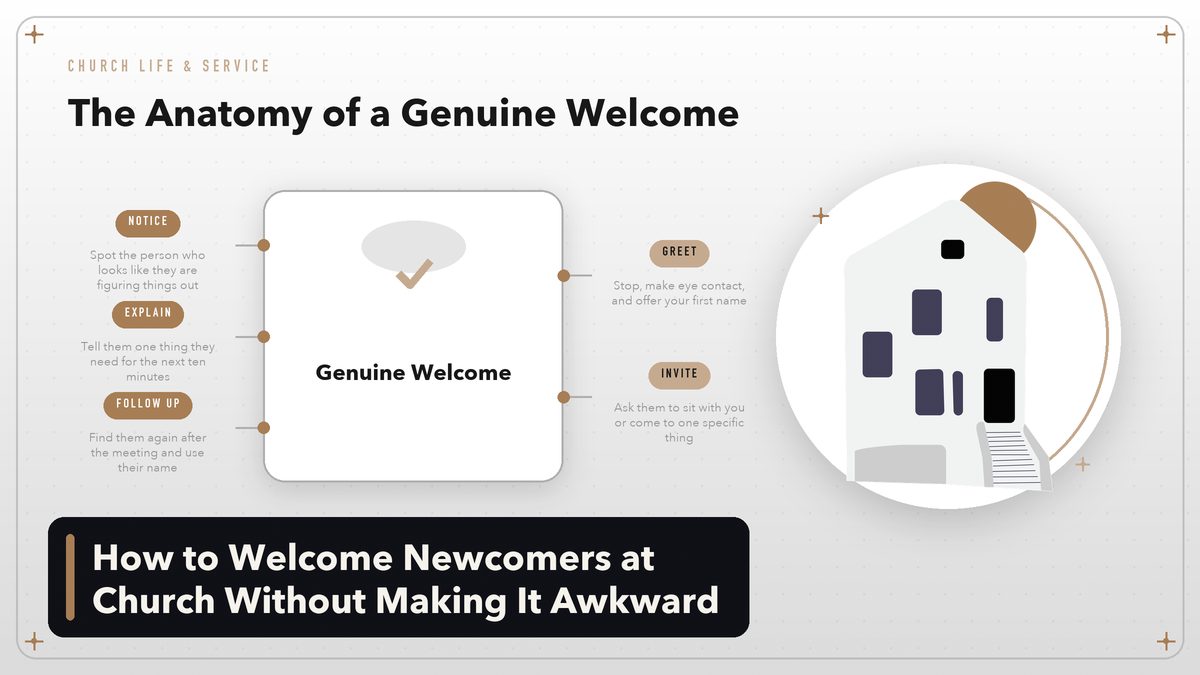
The Anatomy of a Genuine Welcome
Five simple parts that turn a stranger into a guest
A genuine welcome is not a performance. It does not require charisma, a calling, or a memorized script. It is made of a few small actions most of us can do if we slow down. Think of it as having five parts, and the beauty is you can practice them one at a time.

1. Notice before you greet
The hardest part is often the first: actually seeing the newcomer. Most of us walk into sacrament meeting on autopilot. We know our row, our friends, the spot where the sun does not hit our eyes. We could make the trip with our eyes closed. That familiarity is comfortable, and it also makes us blind.
Noticing means scanning the room with one question: who here looks like they are figuring things out? It might be the family with out-of-state license plates in the parking lot. It might be the single adult sitting alone with a printed program turned upside down. It might be the teenager wearing headphones in the foyer who is waiting for a parent. The person does not need to look lost. They just need to look new.
2. Greet with your whole attention
Once you notice someone, the greeting matters. A rushed “Good morning” while you are walking past does not count. A real greeting stops briefly, makes eye contact, and offers a name. It sounds simple because it is. “Hi, I am Marcus. I do not think we have met.” That one sentence opens the door without forcing anyone through it.
If the person is shy, a handshake might feel like too much. If they are carrying a toddler, they may not have a free hand. Watch the cues. Sometimes a warm smile and an open gesture are enough. The goal is not to be impressive. The goal is to be present.
3. Explain one thing
Newcomers are swimming in unknowns. They do not know when to stand, where the nursery is, or why everyone calls the meeting “sacrament meeting.” One clear explanation cuts through the fog. You do not need to give a tour. Just give them the next thing.
If the meeting is about to start, try this: “We will begin with a hymn and an opening prayer, and then the sacrament will be passed to the congregation. After that, members of the congregation will give short talks.” That single sentence removes a lot of anxiety. The Teaching in the Savior’s Way manual teaches that clarity and love go together. When we explain simply, we show respect.
4. Invite them to something specific
Vague invitations are easy to ignore. “Let me know if you need anything” places the burden back on the newcomer. A specific invitation is much more useful. “Would you like to sit with us?” “Can I introduce you to the Primary president?” “We are having a potluck after church. I would love for you to come.” These invitations are low pressure but concrete.
The invitation does not have to be large. It just has to be real. If you are not in a position to host someone for dinner, invite them to sit by you. If you do not know the answer to a question, invite them to meet someone who does. Every specific invitation says, “There is a place for you here.”
5. Follow up without stalking
The final part is the easiest to skip and the most important to remember. After the meeting, find the person again. Ask how their morning was. Introduce them to one more person. If they gave you their name, use it. If they mentioned a child, ask about the child. A five-second follow-up signals that the first greeting was not a duty. It was the start of a relationship.
The First 60 Seconds After Someone Sits Down
A simple flow for the moment you spot someone new
The hardest window is the first minute. If we do not act quickly, the meeting starts, the opportunity closes, and the newcomer spends the next hour feeling like an observer rather than a guest. Having a simple flow in mind helps you move from noticing to welcoming without overthinking it.

Here is what the first minute can look like in practice. You walk into the chapel, glance around, and see a woman checking her phone near the back. You move toward her. Not because you are assigned to greet, but because you decided ahead of time that this is part of your Sunday worship. You introduce yourself. You ask, “Is this your first time here, or are you visiting from another ward?” That question is better than “Are you new?” because it gives her options and does not assume anything.
She says she just moved into the area. You tell her you are glad she came. You point to the program and explain that the sacrament will be passed after the first hymn. Then you offer a specific next step: “Would you like to sit with us? We are two rows up on the left.” If she accepts, great. If she prefers to sit alone, that is fine too. The invitation was clear and respectful either way.
The point of the flow is not to create a script. It is to remove hesitation. When you already know the shape of the moment, you spend less energy worrying about what to say and more energy actually listening to the person in front of you.
Helping Without Hovering
The difference between hospitality and pressure
There is a fine line between making someone feel welcome and making them feel watched. Most of us have good intentions, but good intentions can become overwhelming if we forget to give people space. A newcomer does not need a personal escort for the entire three-hour block. They need one or two people who are available without being suffocating.

| Hovering | Helping |
|---|---|
| Asks three questions before they have sat down | Opens with one warm greeting and waits |
| Follows them from the chapel to the hallway | Offers a clear next step and lets them choose |
| Explains every acronym, program, and class | Explains just enough for the next ten minutes |
| Expects them to commit to a calling or activity | Invites them to come back next week, no strings attached |
Think of it like holding a door. You can hold a door open for someone and let them walk through at their own pace. You cannot shove them through it and call it hospitality. The same is true at church. A helpful welcome creates an on-ramp. A hovering welcome creates an obstacle course.
This matters especially for people who are introverted, neurodivergent, or coming from a different religious background. They may need more time and less intensity. A gentle greeting, a clear explanation, and a calm invitation to sit somewhere quiet can be far more welcoming than a burst of enthusiasm.
What to Say When You Do Not Know What to Say
A few openers that actually work
Many members avoid welcoming newcomers because they are afraid of saying the wrong thing. They worry about being awkward, intrusive, or accidentally offensive. That fear is understandable, and it is also a poor excuse for silence. A slightly awkward hello is almost always better than no hello at all.
Here are a few phrases that work in real life. They are open-ended without being pushy, friendly without being fake.
- “I do not think we have met.” It is honest, low pressure, and gives the other person room to explain.
- “Is this your first time here, or are you visiting from another ward?” This avoids the assumption that someone is new and respects longtime members who may just be passing through.
- “I am glad you are here.” Simple and sincere. It costs nothing and means a lot.
- “Can I help you find anything?” Useful in the foyer or hallway when someone looks uncertain.
- “Would you like to sit with us?” A concrete invitation that gives the person an immediate sense of belonging.
Avoid questions that put people on the spot about their beliefs, their past, or why they came. “Have you been baptized?” or “Are you a member?” can feel like a test. Save those conversations for later, when trust has been built. The first greeting is about belonging, not membership status.
You do not need the perfect words. You need the courage to use your own words.
Making Welcoming a Ward Habit
One person can start it, but a ward can sustain it
Individual efforts matter, but a welcoming culture is stronger than any single greeter. Wards that make hospitality a habit tend to do a few things consistently. They notice. They train. They follow up. They celebrate the small wins. These habits do not require a budget or a calling. They require intention.
In an April 2016 general conference address, Elder Patrick Kearon reminded us that the Savior’s disciples are known by how they treat the stranger, the refugee, and the outsider. The principle applies inside our chapels too. The person sitting alone is not an interruption to our Sunday routine. They are the reason we are gathered.
Here are a few ways a ward can make welcoming part of its culture without creating another program:
- Assign a rotating “new-face watch.” Each week, one or two families make it their personal goal to look for someone they do not recognize and offer a genuine greeting.
- Put welcoming language in announcements. A bishopric can occasionally remind the congregation that visitors are welcome and that members should introduce themselves to someone new.
- Invite newcomers to the next simple event. A picnic, a cleanup day, or a youth activity can be easier to attend than a formal dinner at a stranger’s house.
- Ask for feedback. A short conversation with a recent convert about their first month can reveal what helped and what felt overwhelming.
- Model it from the front. When leaders greet people warmly before and after meetings, others follow.
Welcoming is contagious in the best way. When one person makes it normal, others start doing it too. Within a few months, the entire tone of a ward can shift from cliquey to open without a single meeting being held.
When the Newcomer Is Your Neighbor, Not a Stranger
Recent converts and returning members need a different kind of welcome
Not every newcomer is a first-time visitor. Some are recent converts who have been taught by missionaries and are now trying to figure out how a ward actually works. Some are returning members who have been away for years and are nervous about walking through the door. Some are teenagers who came because a friend invited them and are wondering if anyone will talk to them.
Each of these people needs something slightly different. A recent convert may need someone to explain the schedule of classes and introduce them to the Relief Society or elders quorum president. A returning member may need a quiet acknowledgment that does not draw attention. A teenager may need someone close to their own age to say hello. A parent with a child with special needs may need practical help finding the right classroom rather than a long conversation.
The common thread is curiosity. Instead of assuming what someone needs, ask. “What would make this morning easier for you?” is a powerful question. It gives the person dignity and gives you direction. Sometimes the answer is as simple as “a place to change my baby” or “someone to sit with me during sacrament meeting.”
Starting Where You Are
You do not have to fix the whole ward today
If reading this makes you feel overwhelmed, start smaller. You do not need to reorganize the ward’s greeter schedule or memorize a theology lecture. You just need to be the person who notices one new face this Sunday and says something kind.
Pick one action. Maybe it is greeting the person who sits alone. Maybe it is explaining the sacrament to a visitor. Maybe it is inviting a new family to the ward activity. Maybe it is simply learning one person’s name and praying for them during the week. One action, repeated, becomes a habit. A habit, shared, becomes a culture.
The Savior spent much of His ministry noticing people others overlooked. He asked questions. He ate with strangers. He made room for the outsider. We will not be perfect at it, but we can move in that direction. Every time we choose open arms over folded ones, we make our wards a little more like the place He intended them to be.
External sources checked live before publishing: “Welcome with Open Arms or Arms Folded,” October 2001 general conference; “Welcoming Others,” October 2008 general conference; “The Greatest Among You,” April 2016 general conference; Gospel Topics: Ministering; and the Teaching in the Savior’s Way manual.